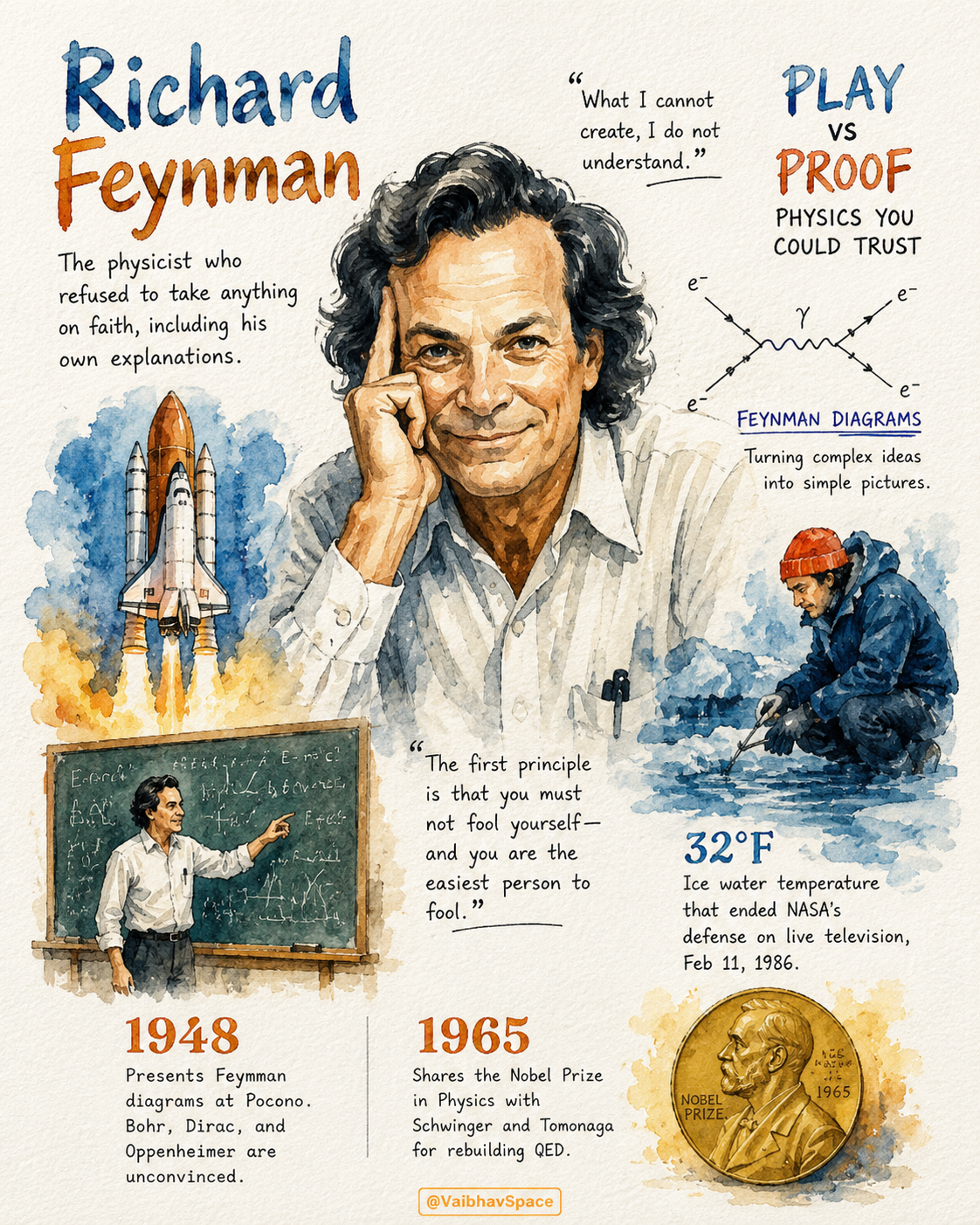
The physicist who refused to take anything on faith, including his own explanations.
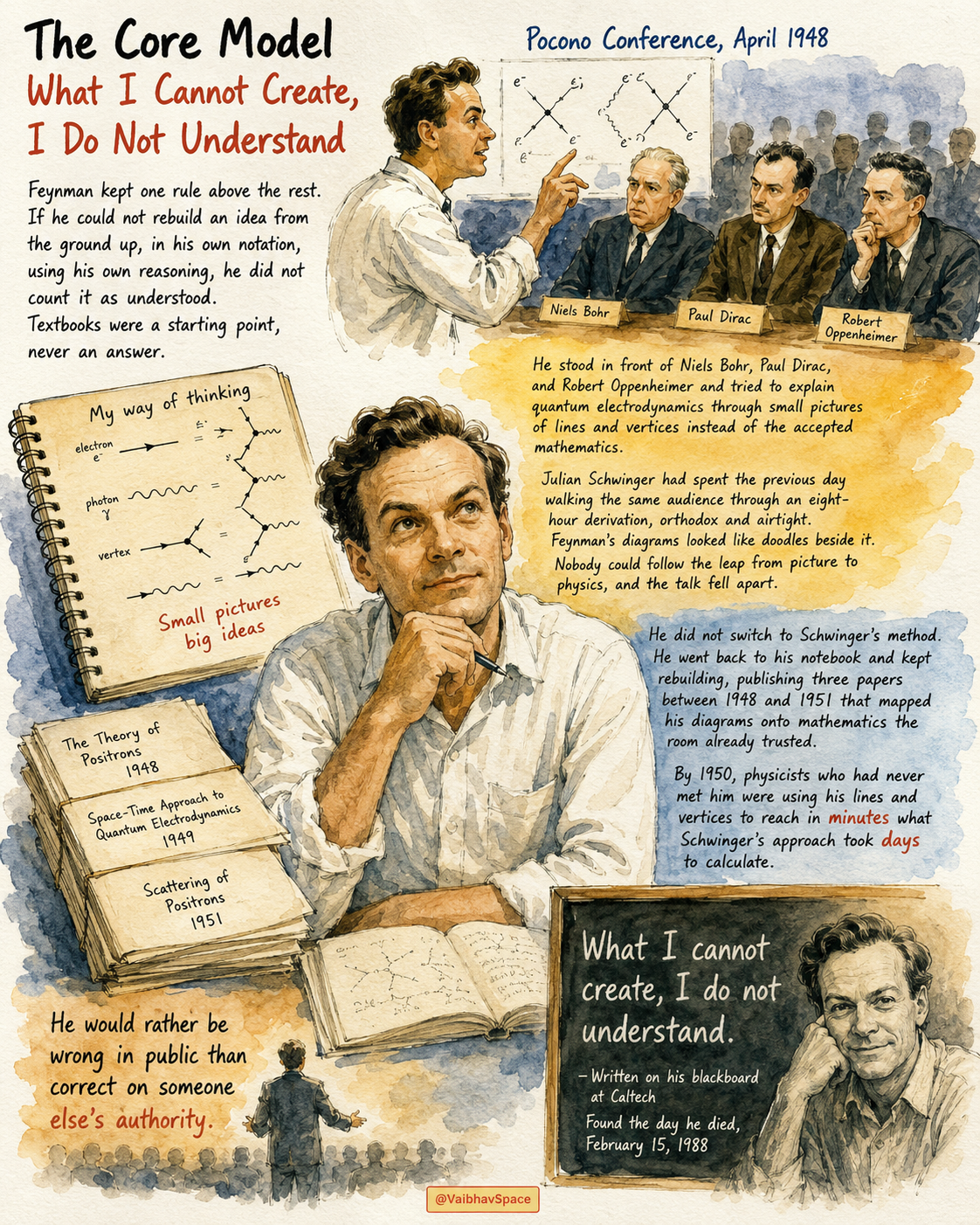
Feynman kept one rule above the rest. If he could not rebuild an idea from the ground up, in his own notation, using his own reasoning, he did not count it as understood. Textbooks were a starting point, never an answer.
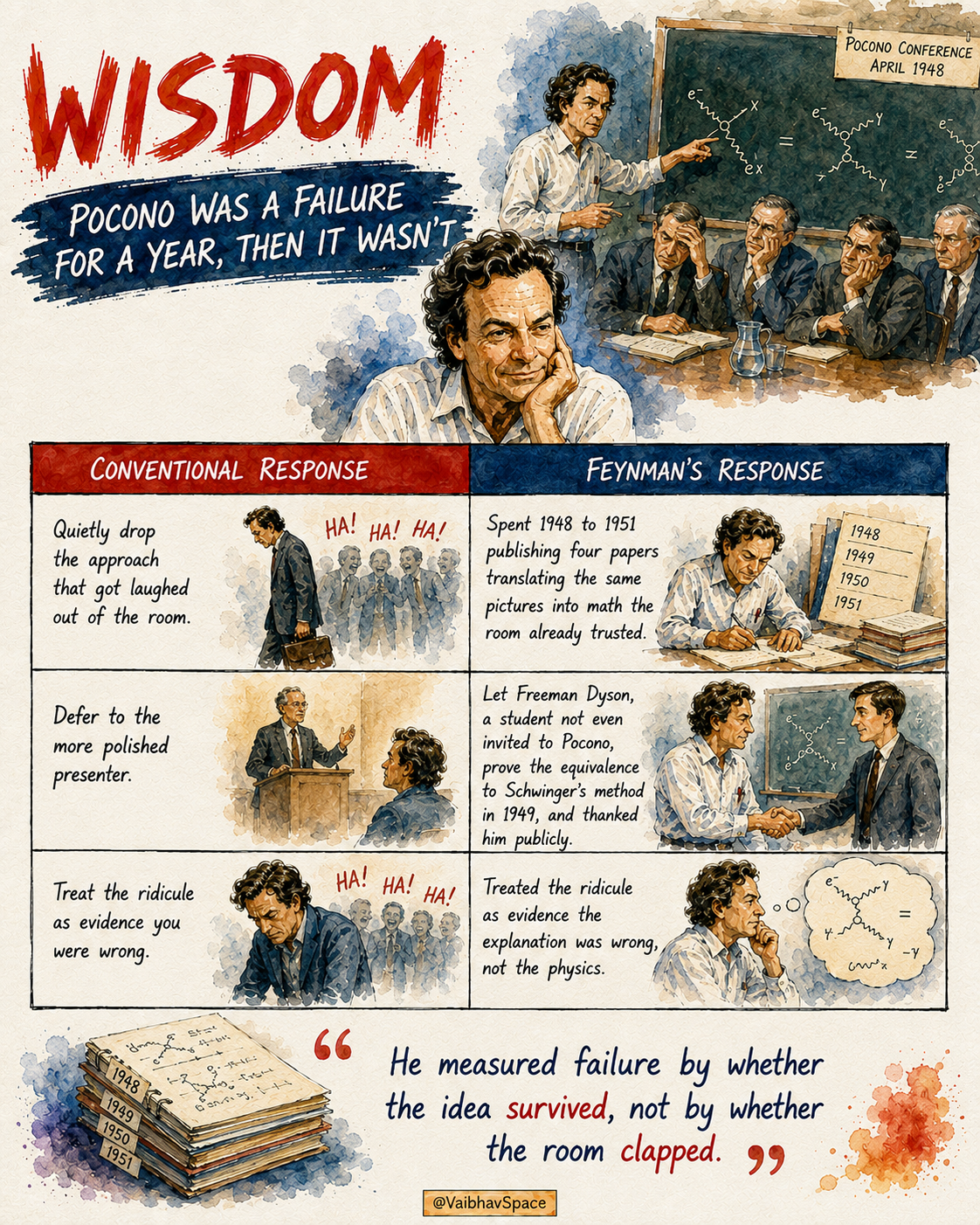
At the Pocono Conference in April 1948, that rule cost him the room. He stood in front of Niels Bohr, Paul Dirac, and Robert Oppenheimer and tried to explain quantum electrodynamics through small pictures of lines and vertices instead of the accepted mathematics. Julian Schwinger had spent the previous day walking the same audience through an eight-hour derivation, orthodox and airtight. Feynman's diagrams looked like doodles beside it. Nobody could follow the leap from picture to physics, and the talk fell apart.
He did not switch to Schwinger's method. He went back to his notebook and kept rebuilding, publishing three papers between 1948 and 1951 that mapped his diagrams onto mathematics the room already trusted. By 1950, physicists who had never met him were using his lines and vertices to reach in minutes what Schwinger's approach took days to calculate.
He would rather be wrong in public than correct on someone else's authority.
“What I cannot create, I do not understand.”Written on his blackboard at Caltech, found the day he died, February 15, 1988
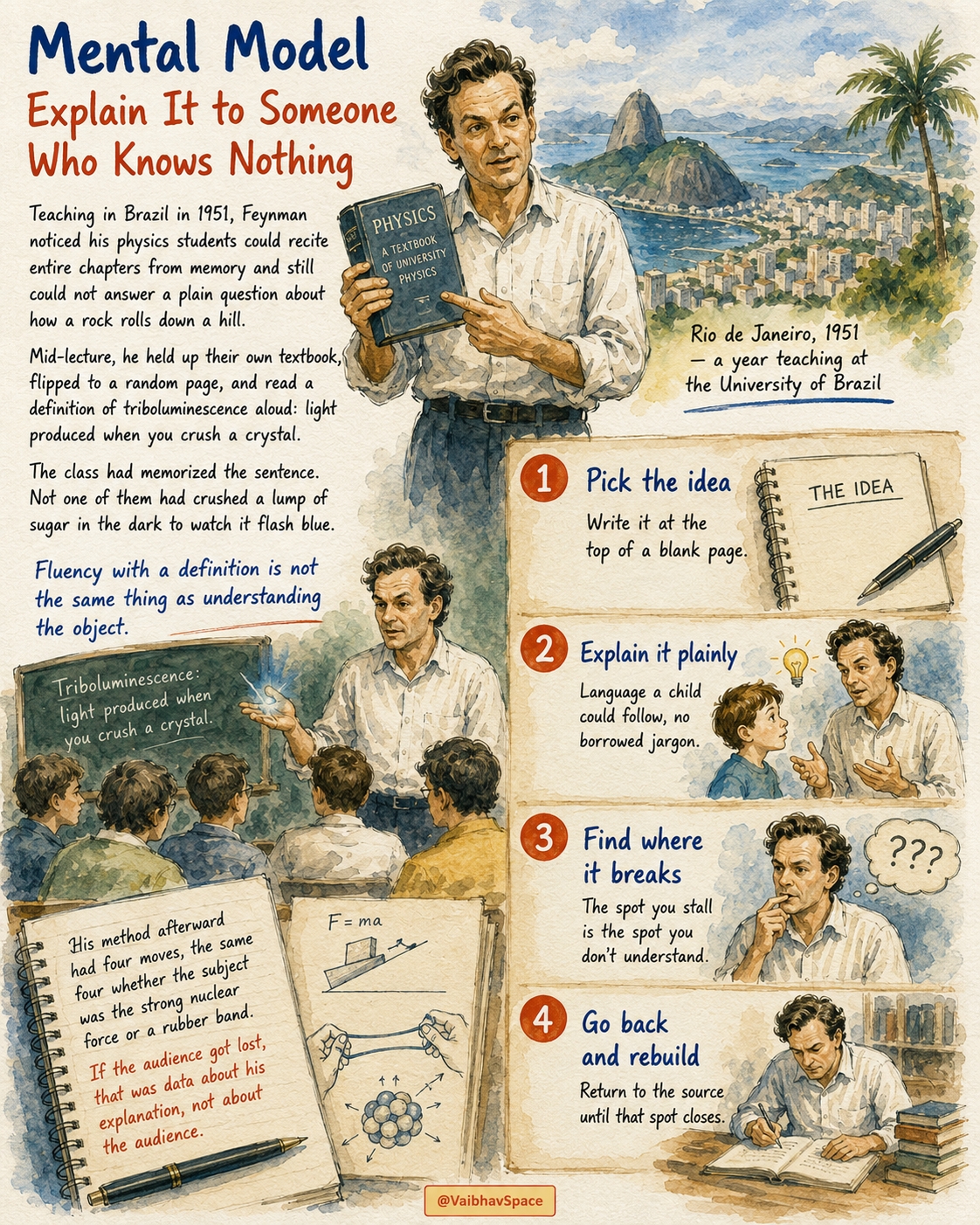
Teaching in Brazil in 1951, Feynman noticed his physics students could recite entire chapters from memory and still could not answer a plain question about how a rock rolls down a hill. Mid-lecture, he held up their own textbook, flipped to a random page, and read a definition of triboluminescence aloud: light produced when you crush a crystal. The class had memorized the sentence. Not one of them had crushed a lump of sugar in the dark to watch it flash blue.
His method afterward had four moves, the same four whether the subject was the strong nuclear force or a rubber band. If the audience got lost, that was data about his explanation, not about the audience.
Fluency with a definition is not the same thing as understanding the object.
In his 1974 commencement address at Caltech, Feynman described islanders in the South Pacific who, after watching wartime airfields fill with cargo, built their own runways, control towers, and bamboo antennas once the war ended. They copied every visible motion of the system that had produced planes full of supplies. No plane ever landed, because the copying stopped at the surface.
He used the story for research that wears every outward form of science, controls, statistics, publication, and still produces nothing that holds up under a second look. His fix was one sentence: report everything that could make your own result wrong, not only what supports it. He called this leaning over backwards, and treated it as a discipline to practice, not a virtue some people simply have.
Following the form of a method is not the same as being bound by it.
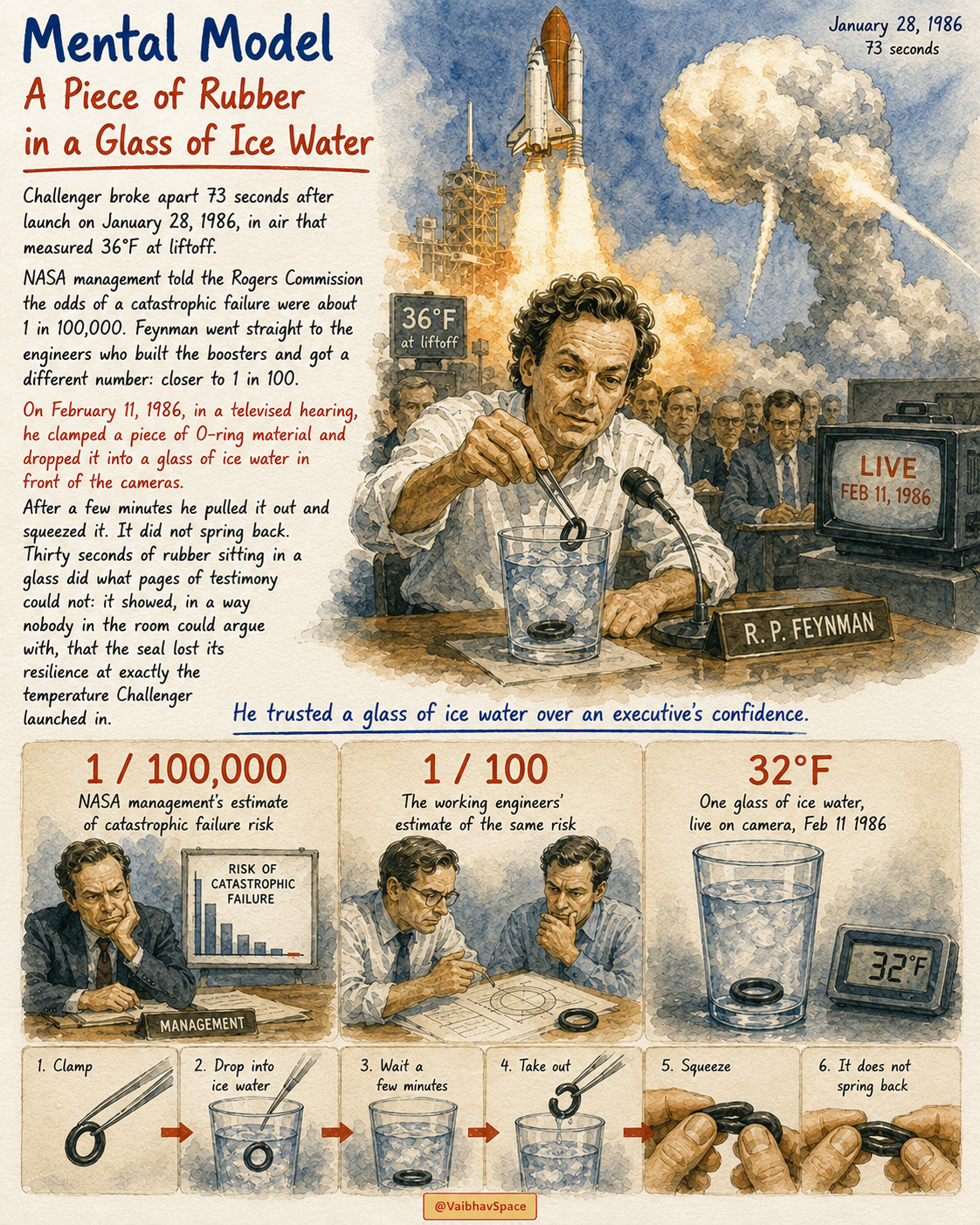
Challenger broke apart 73 seconds after launch on January 28, 1986, in air that measured 36°F at liftoff. NASA management told the Rogers Commission the odds of a catastrophic failure were about 1 in 100,000. Feynman went straight to the engineers who built the boosters and got a different number: closer to 1 in 100.
On February 11, 1986, in a televised hearing, he clamped a piece of O-ring material and dropped it into a glass of ice water in front of the cameras. After a few minutes he pulled it out and squeezed it. It did not spring back. Thirty seconds of rubber sitting in a glass did what pages of testimony could not: it showed, in a way nobody in the room could argue with, that the seal lost its resilience at exactly the temperature Challenger launched in.
He trusted a glass of ice water over an executive's confidence.
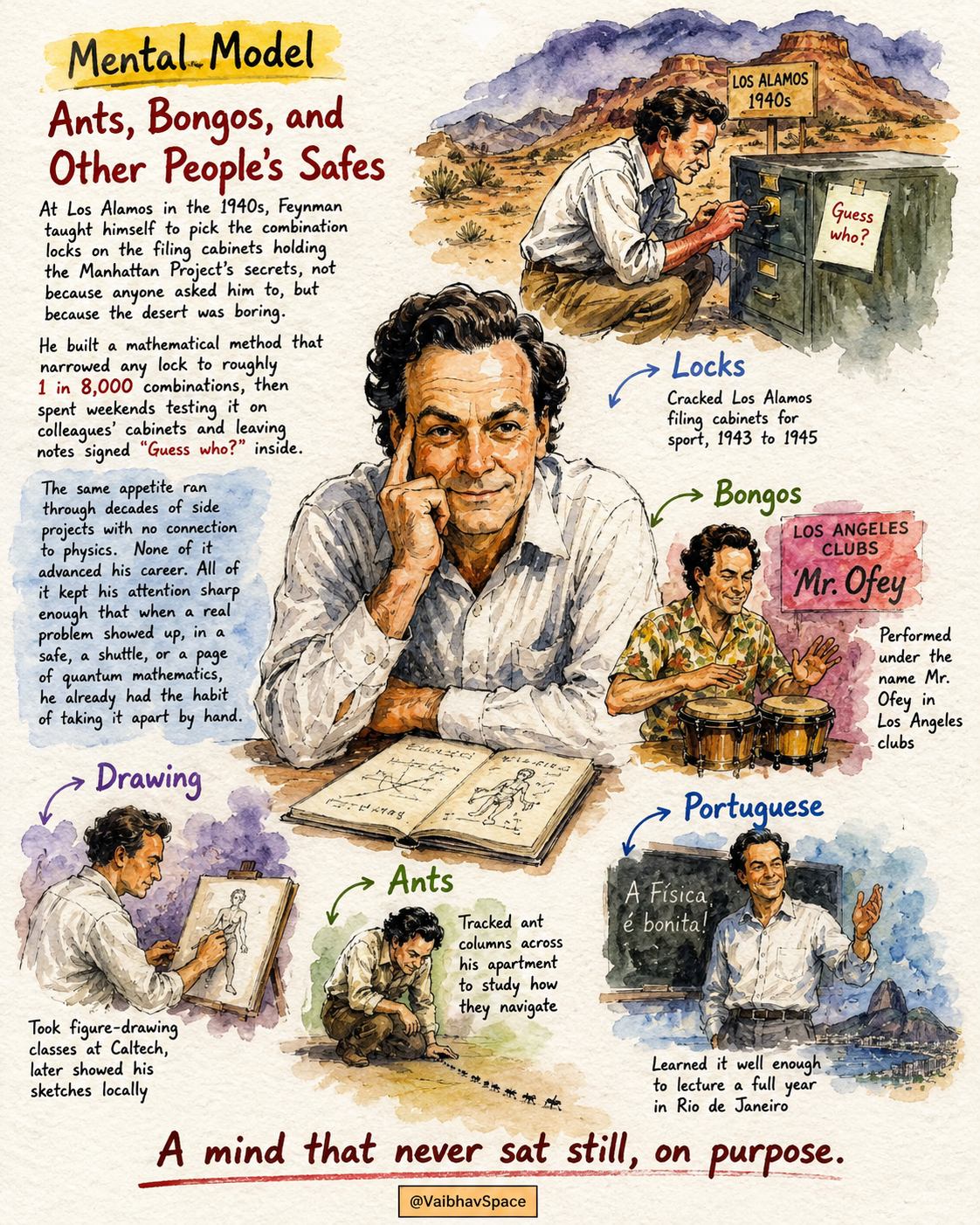
At Los Alamos in the 1940s, Feynman taught himself to pick the combination locks on the filing cabinets holding the Manhattan Project's secrets, not because anyone asked him to, but because the desert was boring. He built a mathematical method that narrowed any lock to roughly 1 in 8,000 combinations, then spent weekends testing it on colleagues' cabinets and leaving notes signed “Guess who?” inside.
The same appetite ran through decades of side projects with no connection to physics. None of it advanced his career. All of it kept his attention sharp enough that when a real problem showed up, in a safe, a shuttle, or a page of quantum mathematics, he already had the habit of taking it apart by hand.
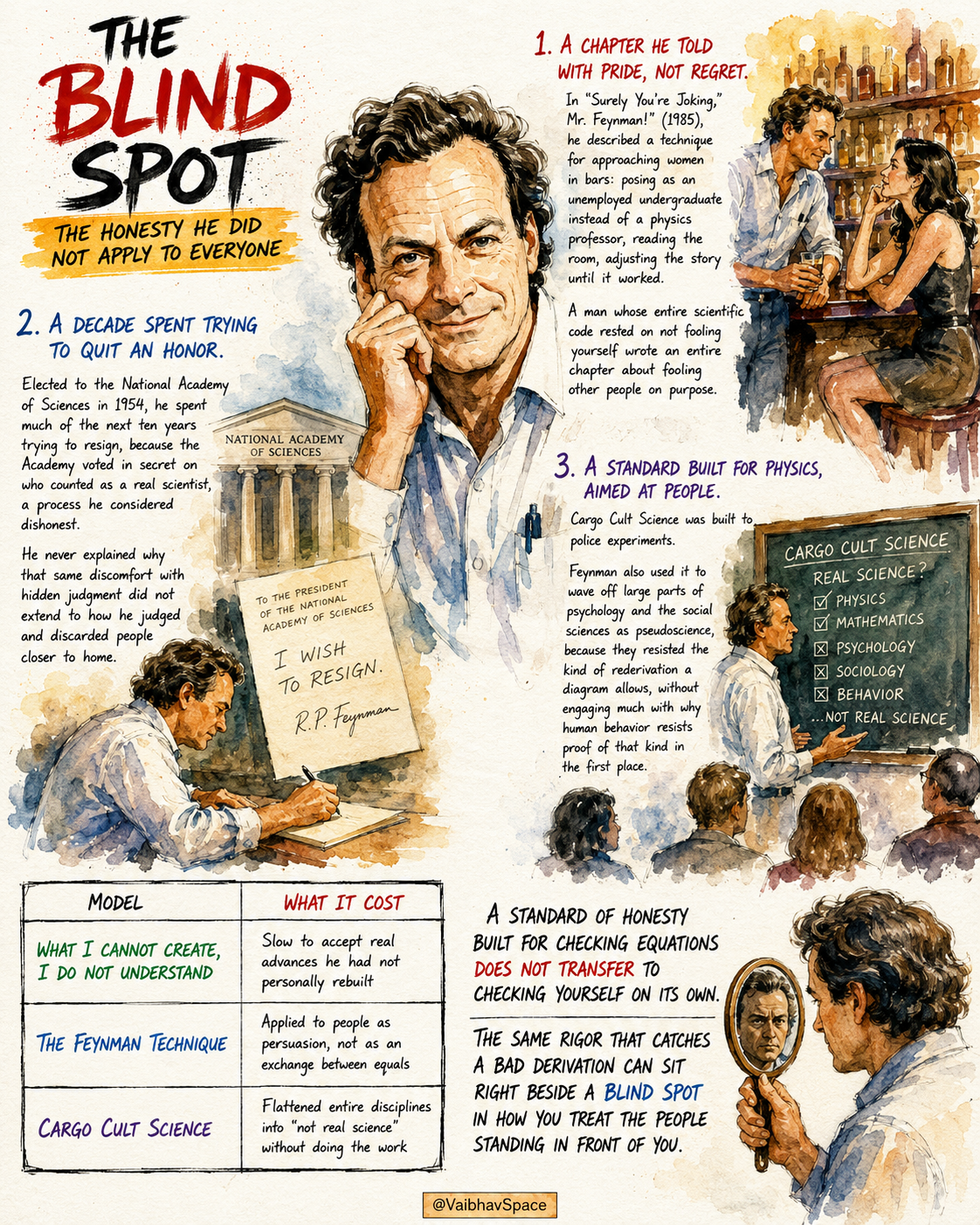
1. A chapter he told with pride, not regret. In “Surely You're Joking, Mr. Feynman!” (1985), he described a technique for approaching women in bars: posing as an unemployed undergraduate instead of a physics professor, reading the room, adjusting the story until it worked. A man whose entire scientific code rested on not fooling yourself wrote an entire chapter about fooling other people on purpose.
2. A decade spent trying to quit an honor. Elected to the National Academy of Sciences in 1954, he spent much of the next ten years trying to resign, because the Academy voted in secret on who counted as a real scientist, a process he considered dishonest. He never explained why that same discomfort with hidden judgment did not extend to how he judged and discarded people closer to home.
3. A standard built for physics, aimed at people. Cargo Cult Science was built to police experiments. Feynman also used it to wave off large parts of psychology and the social sciences as pseudoscience, because they resisted the kind of rederivation a diagram allows, without engaging much with why human behavior resists proof of that kind in the first place.
| Model | What It Cost |
|---|---|
| What I Cannot Create, I Do Not Understand | Slow to accept real advances he had not personally rebuilt |
| The Feynman Technique | Applied to people as persuasion, not as an exchange between equals |
| Cargo Cult Science | Flattened entire disciplines into “not real science” without doing the work |
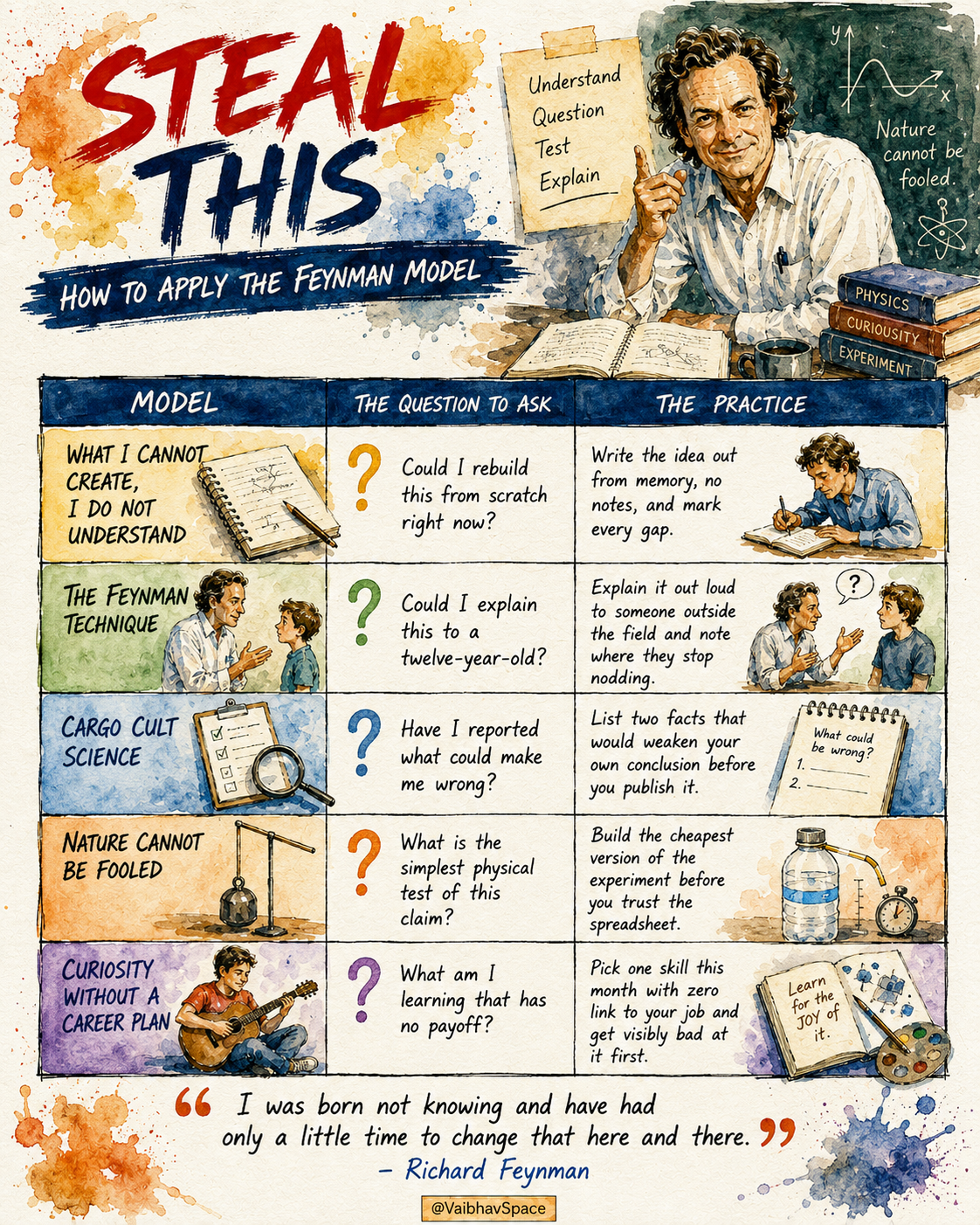
| Model | The Question to Ask | The Practice |
|---|---|---|
| What I Cannot Create, I Do Not Understand | Could I rebuild this from scratch right now? | Write the idea out from memory, no notes, and mark every gap. |
| The Feynman Technique | Could I explain this to a twelve-year-old? | Explain it out loud to someone outside the field and note where they stop nodding. |
| Cargo Cult Science | Have I reported what could make me wrong? | List two facts that would weaken your own conclusion before you publish it. |
| Nature Cannot Be Fooled | What is the simplest physical test of this claim? | Build the cheapest version of the experiment before you trust the spreadsheet. |
| Curiosity Without a Career Plan | What am I learning that has no payoff? | Pick one skill this month with zero link to your job and get visibly bad at it first. |
“I was born not knowing and have had only a little time to change that here and there.”Richard Feynman
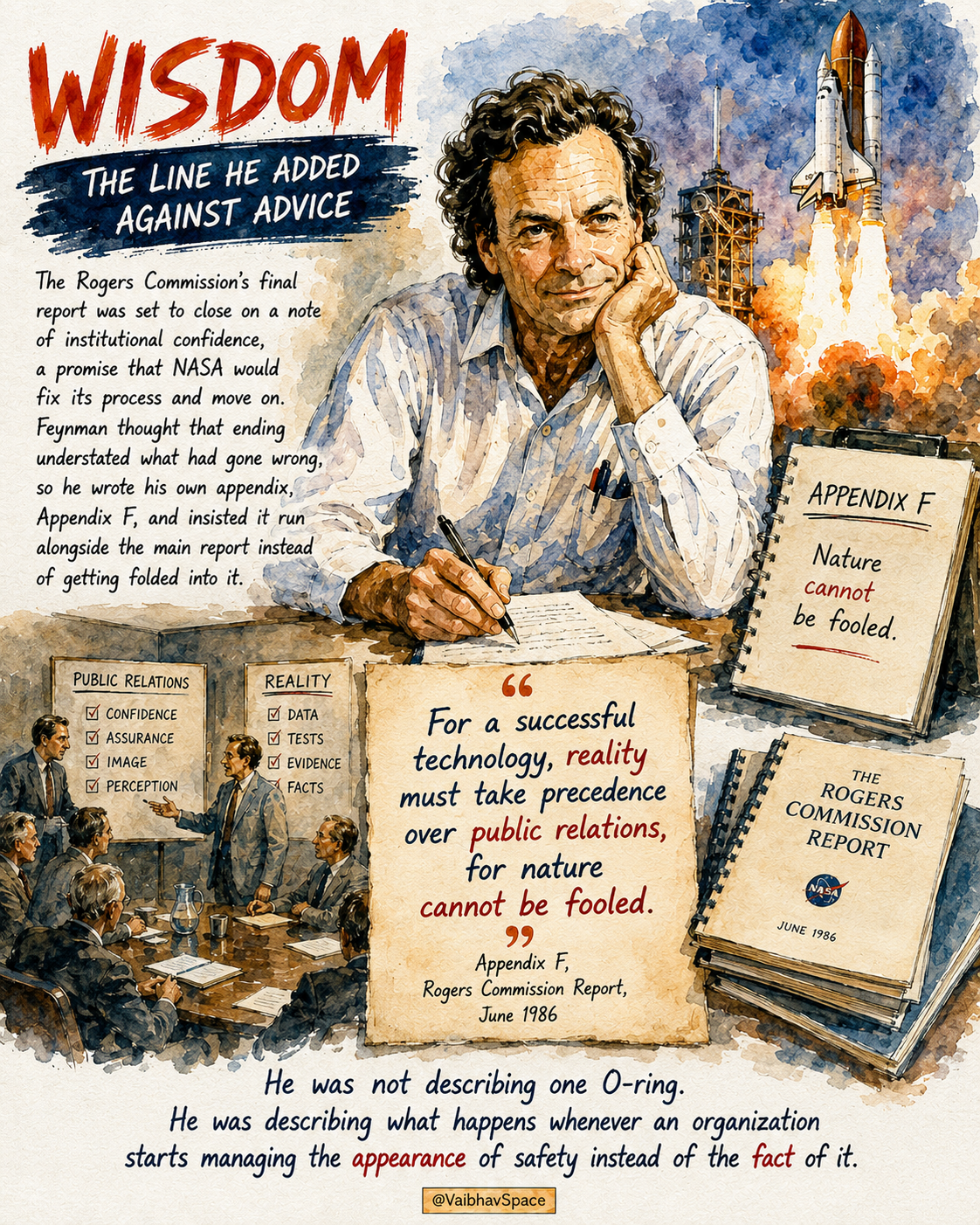
The Rogers Commission's final report was set to close on a note of institutional confidence, a promise that NASA would fix its process and move on. Feynman thought that ending understated what had gone wrong, so he wrote his own appendix, Appendix F, and insisted it run alongside the main report instead of getting folded into it.
“For a successful technology, reality must take precedence over public relations, for nature cannot be fooled.”Appendix F, Rogers Commission Report, June 1986
He was not describing one O-ring. He was describing what happens whenever an organization starts managing the appearance of safety instead of the fact of it.
He measured failure by whether the idea survived, not by whether the room clapped.
Feynman married Arline Greenbaum in a Staten Island city office on June 29, 1942, with two strangers as witnesses, because no family would attend a wedding to a woman doctors expected to lose to tuberculosis within two years. He drove the 200 miles between Los Alamos and her sanatorium in Albuquerque most weekends for over two years. She died on June 16, 1945, while he held her hand, weeks before he watched the Trinity test light up the desert.
Sixteen months later, on October 17, 1946, on what would have been their fourth wedding anniversary, he wrote her a letter. He sealed it, never mailed it, and it was found among his papers after his own death in 1988.
The most rational man of his era wrote to a dead woman for a year and a half, not because he believed she could read it, but because writing it made something in him settle. It sits beside his physics without contradicting it. The same person who refused an equation without proof accepted grief on its own terms, without needing it to make sense.
“You, dead, are so much better than anyone else alive.”Letter to Arline Greenbaum, October 17, 1946, never mailed
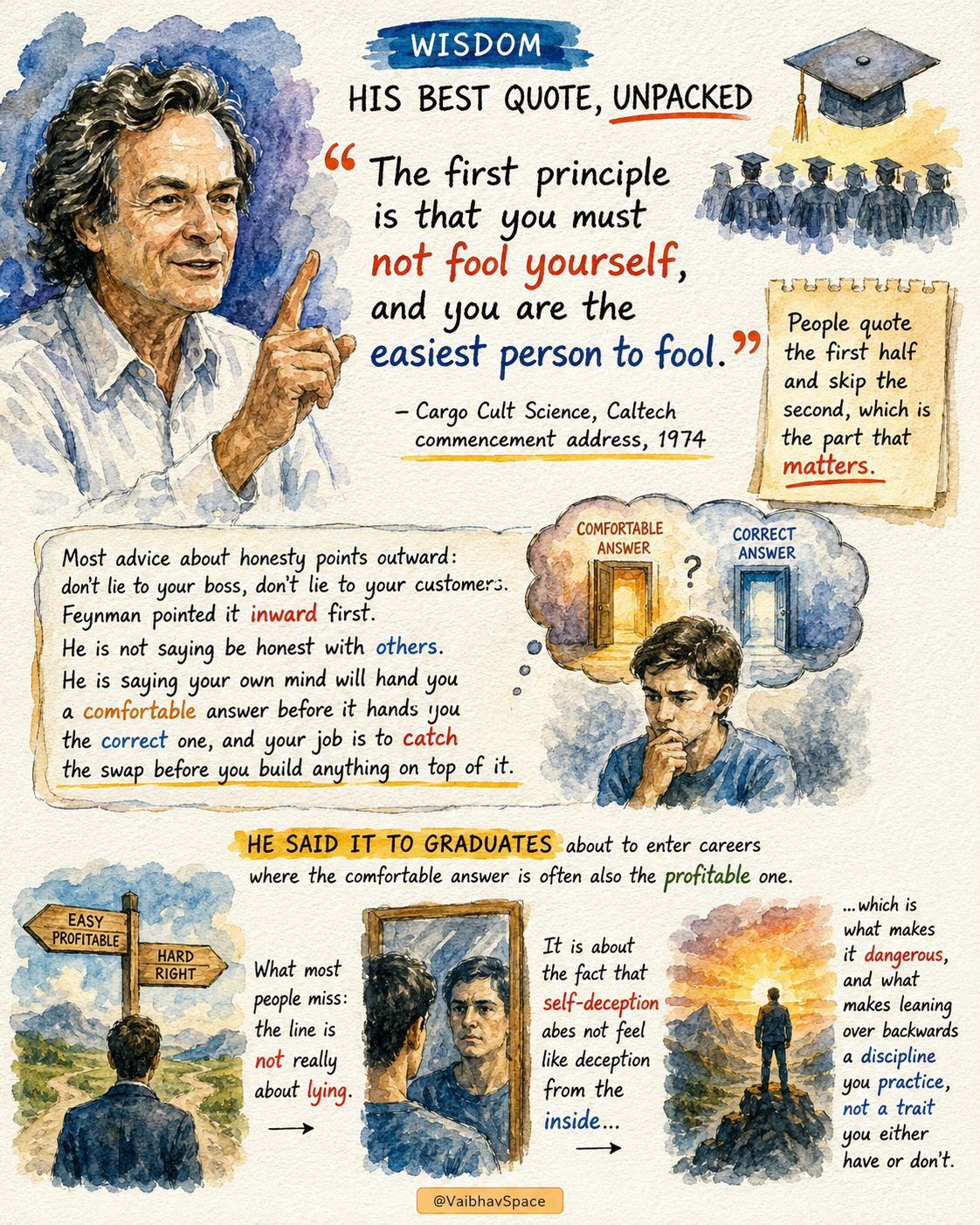
“The first principle is that you must not fool yourself, and you are the easiest person to fool.”Cargo Cult Science, Caltech commencement address, 1974
People quote the first half and skip the second, which is the part that matters. Most advice about honesty points outward: don't lie to your boss, don't lie to your customers. Feynman pointed it inward first. He is not saying be honest with others. He is saying your own mind will hand you a comfortable answer before it hands you the correct one, and your job is to catch the swap before you build anything on top of it.
He said it to graduates about to enter careers where the comfortable answer is often also the profitable one. What most people miss: the line is not really about lying. It is about the fact that self-deception does not feel like deception from the inside, which is what makes it dangerous, and what makes leaning over backwards a discipline you practice, not a trait you either have or don't.
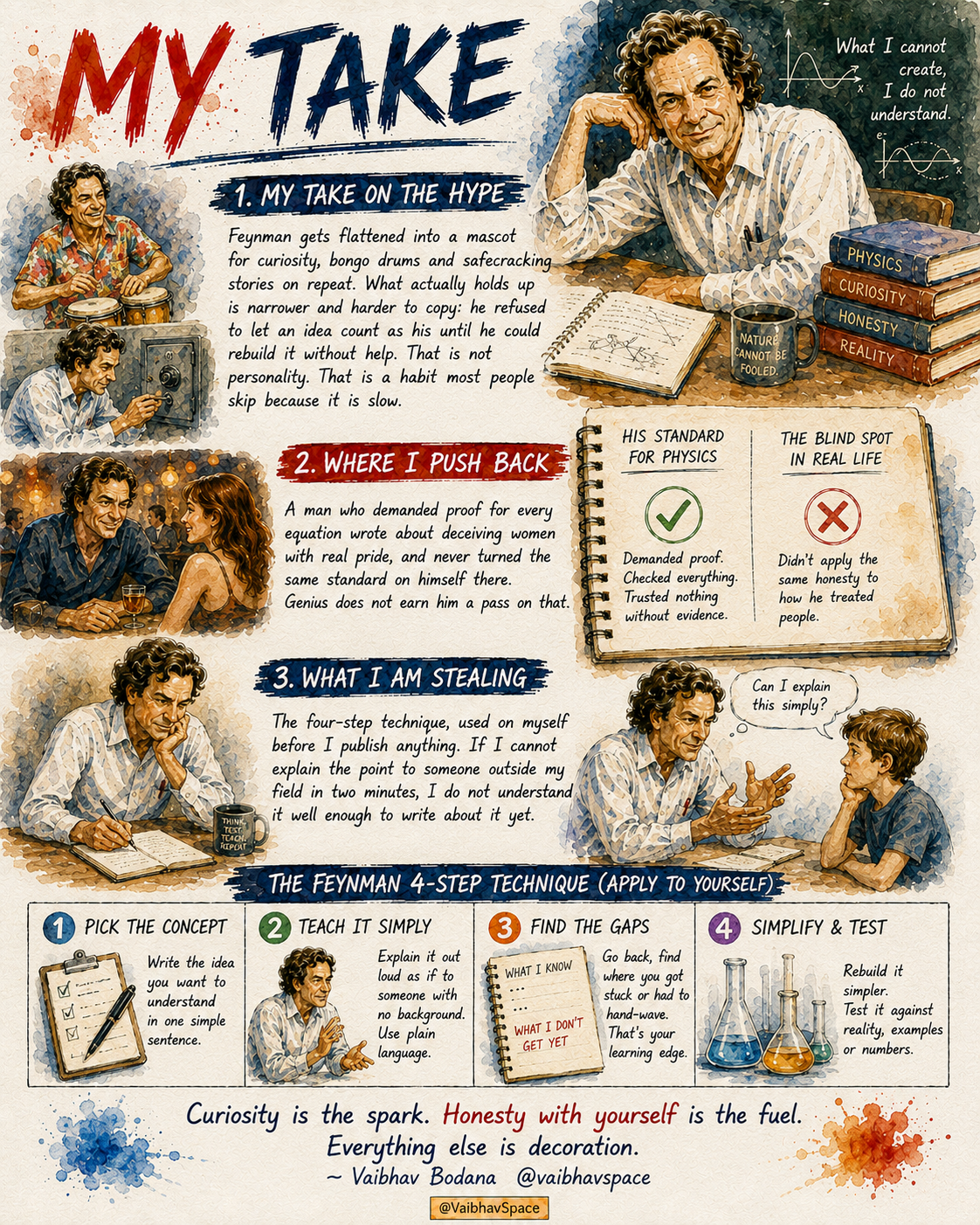
Feynman gets flattened into a mascot for curiosity, bongo drums and safecracking stories on repeat. What actually holds up is narrower and harder to copy: he refused to let an idea count as his until he could rebuild it without help. That is not personality. That is a habit most people skip because it is slow.
Where I push back: a man who demanded proof for every equation wrote about deceiving women with real pride, and never turned the same standard on himself there. Genius does not earn him a pass on that.
What I am stealing: the four-step technique, used on myself before I publish anything. If I cannot explain the point to someone outside my field in two minutes, I do not understand it well enough to write about it yet.