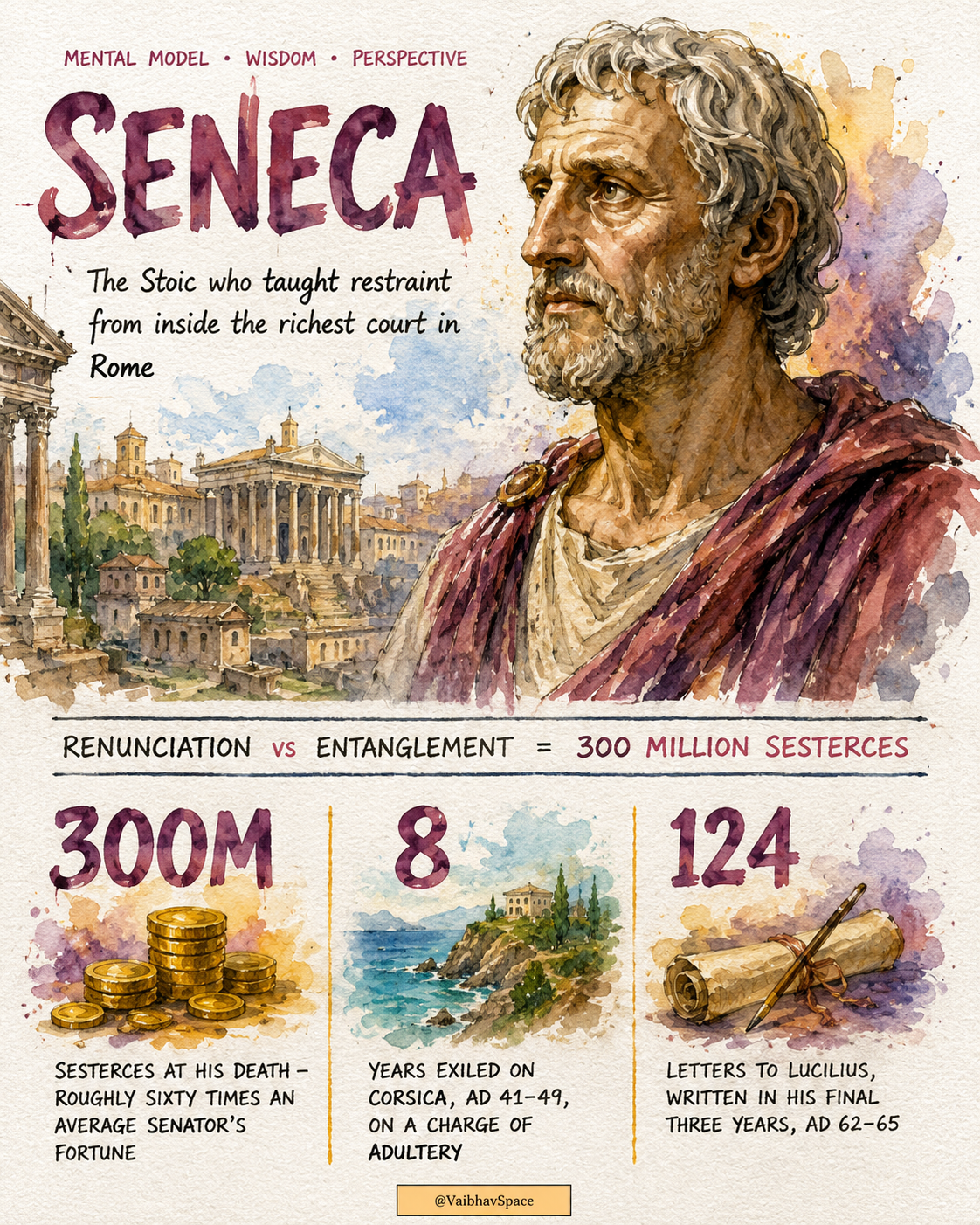
Mental Model • Wisdom • Perspective

SENECA

The Stoic who taught restraint from inside the richest court in Rome

RENUNCIATION vs ENTANGLEMENT = 300 MILLION SESTERCES
300M
Sesterces at his death — roughly sixty times an average senator's fortune
8
Years exiled on Corsica, AD 41–49, on a charge of adultery
124
Letters to Lucilius, written in his final three years, AD 62–65

Rehearse the Wound Before It Cuts

Late summer, AD 64. The colony of Lugdunum, modern Lyon, burned to the ground in a single night. Seneca's friend Liberalis, who loved the city, was shattered by the news.

Seneca wrote to him in Letter 91. His argument was blunt: Liberalis was undone not by the fire itself but by the fact he had never once imagined it. Fortune, Seneca told him, has the same jurisdiction over empires as over emperors.

Across dozens of letters, 91, 63, and 24 among them, Seneca built what later readers named premeditatio malorum: rehearsing loss, illness, exile, and death in specific mental detail before they arrive.

It is not pessimism. It is a drill. Letter 24 tells Lucilius to picture the worst outcome of a pending lawsuit in full color, then notice that it is survivable. Practiced daily, Seneca argued, fortune loses its one real weapon: surprise.
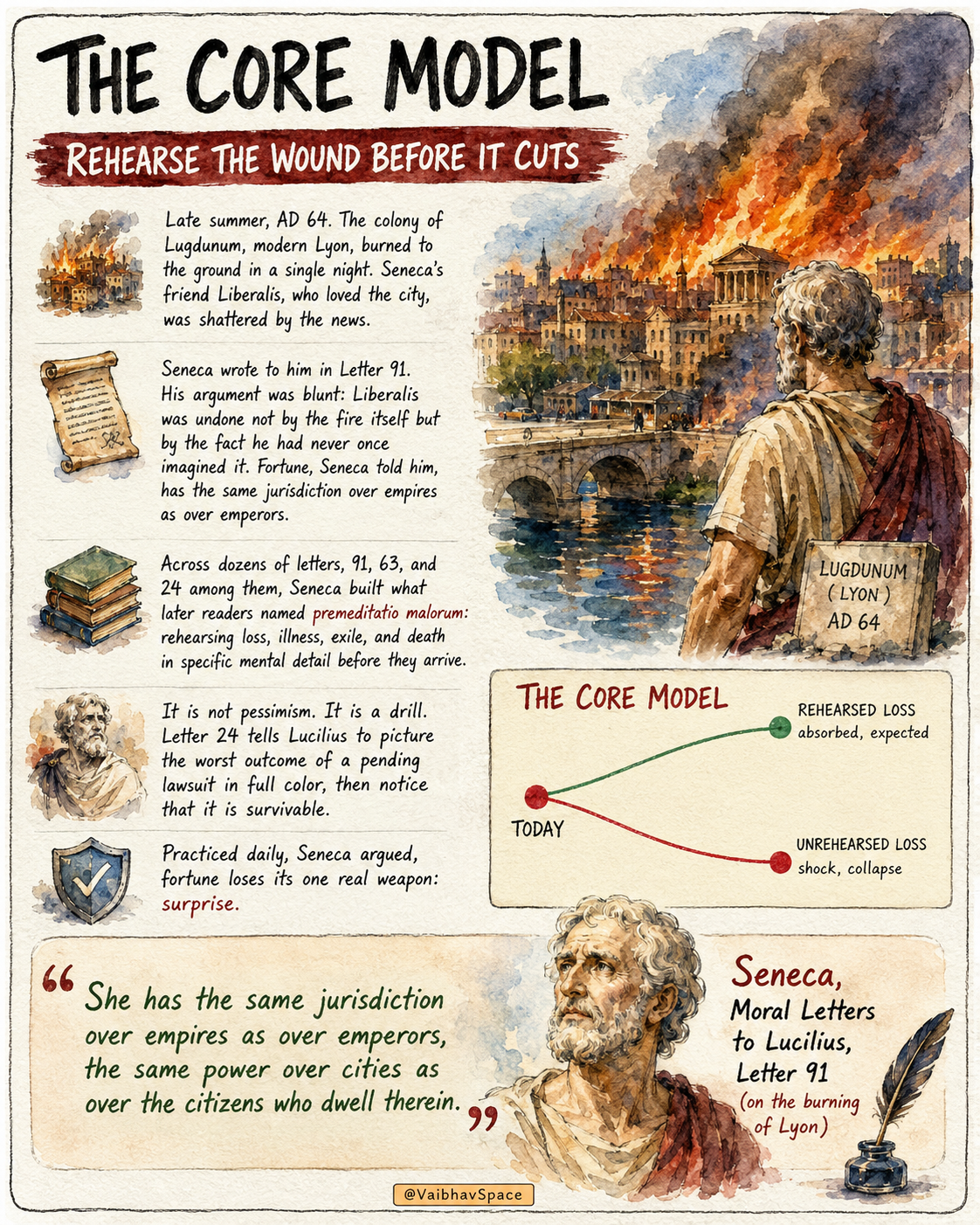
TODAY REHEARSED LOSS absorbed, expected UNREHEARSED LOSS shock, collapse
ONE NIGHT — LUGDUNUM, AD 64

"She has the same jurisdiction over empires as over emperors, the same power over cities as over the citizens who dwell therein."

Seneca, Moral Letters to Lucilius, Letter 91 (on the burning of Lyon)

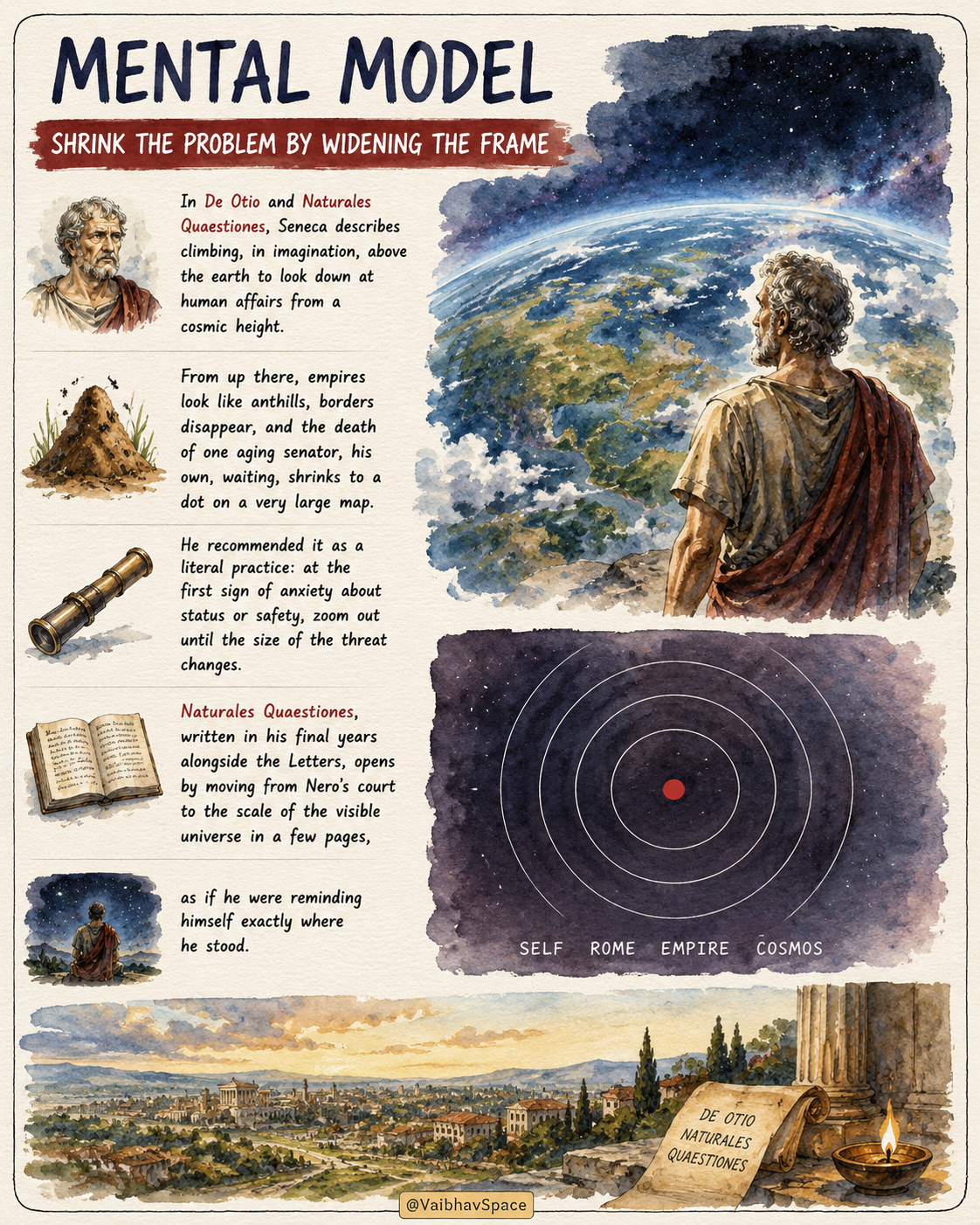
Shrink the Problem by Widening the Frame

SELF ROME EMPIRE COSMOS

In De Otio and Naturales Quaestiones, Seneca describes climbing, in imagination, above the earth to look down at human affairs from a cosmic height.

From up there, empires look like anthills, borders disappear, and the death of one aging senator, his own, waiting, shrinks to a dot on a very large map.

He recommended it as a literal practice: at the first sign of anxiety about status or safety, zoom out until the size of the threat changes.

Naturales Quaestiones, written in his final years alongside the Letters, opens by moving from Nero's court to the scale of the visible universe in a few pages, as if he were reminding himself exactly where he stood.

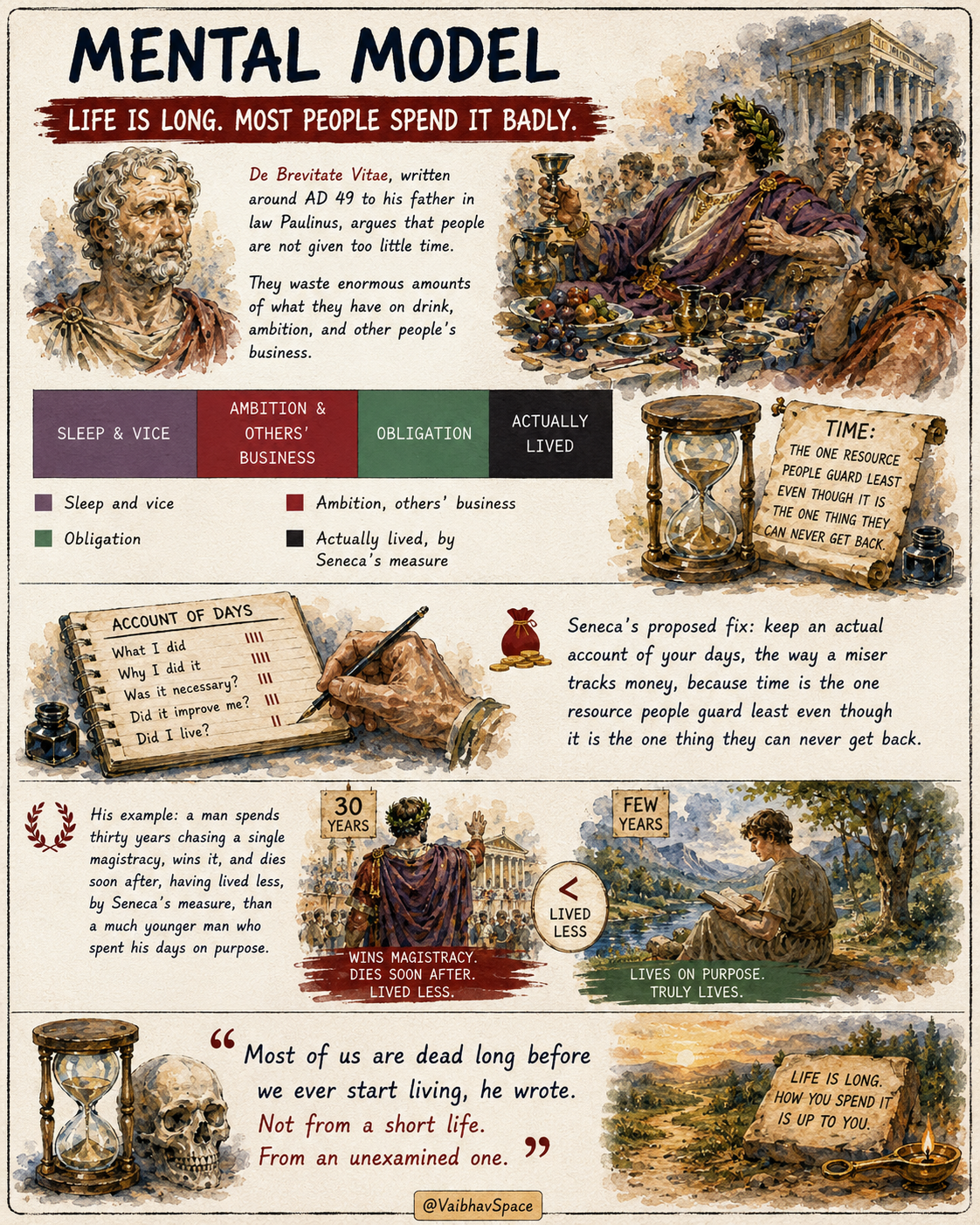
Life Is Long. Most People Spend It Badly.

De Brevitate Vitae, written around AD 49 to his father in law Paulinus, argues that people are not given too little time. They waste enormous amounts of what they have on drink, ambition, and other people's business.

Seneca's proposed fix: keep an actual account of your days, the way a miser tracks money, because time is the one resource people guard least even though it is the one thing they can never get back.

His example: a man spends thirty years chasing a single magistracy, wins it, and dies soon after, having lived less, by Seneca's measure, than a much younger man who spent his days on purpose.

Most of us are dead long before we ever start living, he wrote. Not from a short life. From an unexamined one.

SLEEP & VICE
AMBITION & OTHERS' BUSINESS
OBLIGATION
ACTUALLY LIVED
Sleep and vice
Ambition, others' business
Obligation
Actually lived, by Seneca's measure

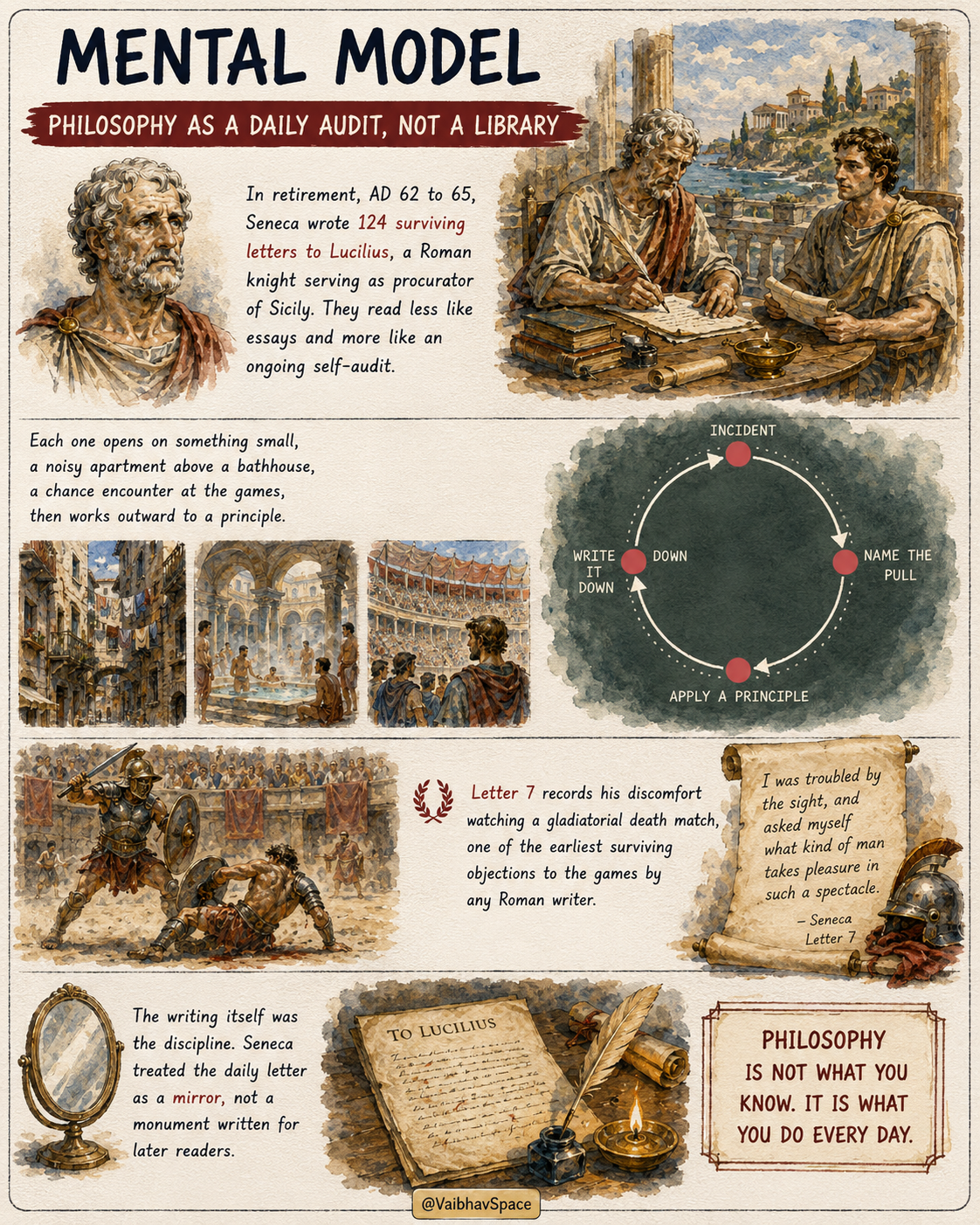
Philosophy as a Daily Audit, Not a Library

INCIDENT NAME THE PULL APPLY A PRINCIPLE WRITE IT DOWN

In retirement, AD 62 to 65, Seneca wrote 124 surviving letters to Lucilius, a Roman knight serving as procurator of Sicily. They read less like essays and more like an ongoing self-audit.

Each one opens on something small, a noisy apartment above a bathhouse, a chance encounter at the games, then works outward to a principle.

Letter 7 records his discomfort watching a gladiatorial death match, one of the earliest surviving objections to the games by any Roman writer.

The writing itself was the discipline. Seneca treated the daily letter as a mirror, not a monument written for later readers.

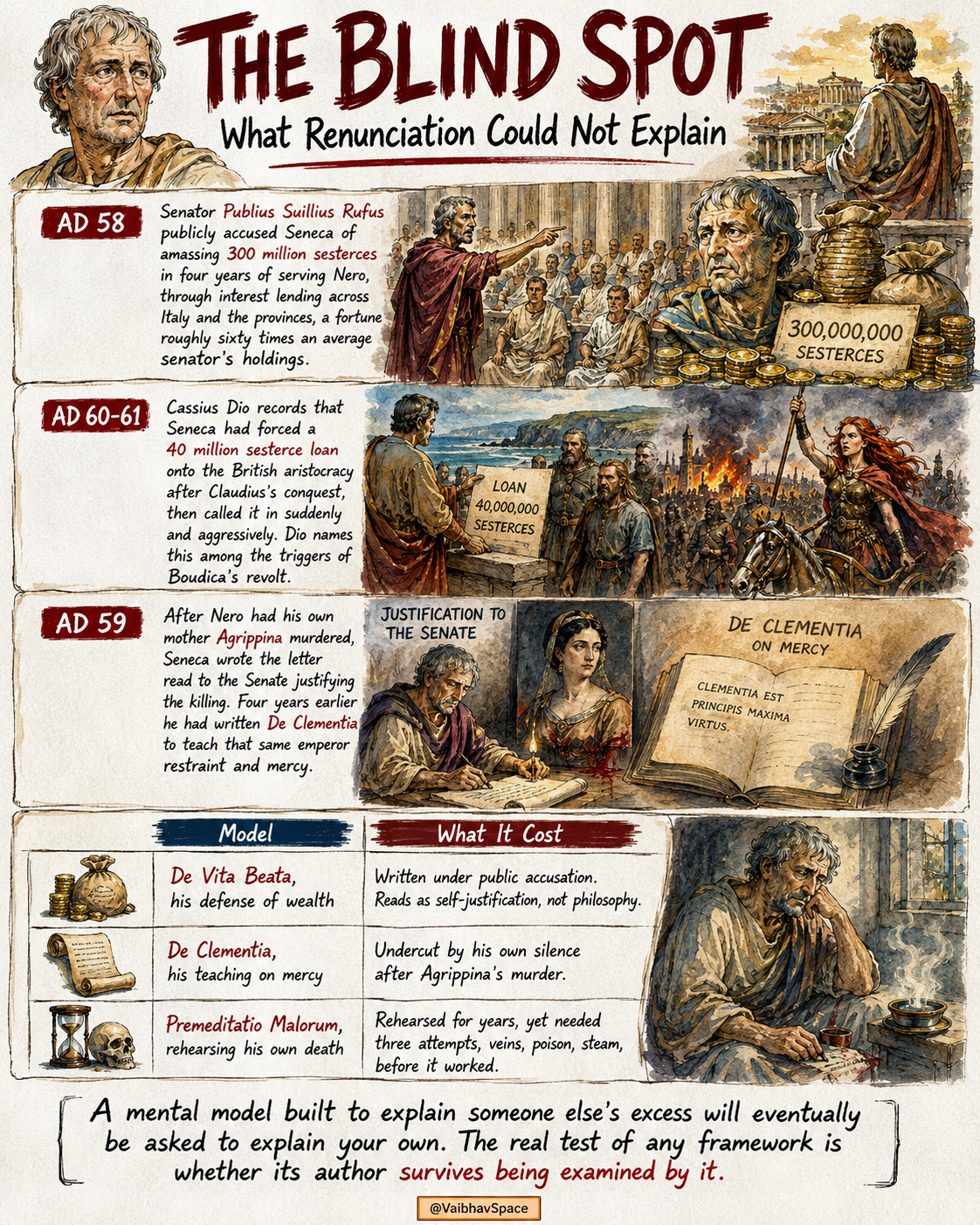
What Renunciation Could Not Explain

AD 58

Senator Publius Suillius Rufus publicly accused Seneca of amassing 300 million sesterces in four years of serving Nero, through interest lending across Italy and the provinces, a fortune roughly sixty times an average senator's holdings.

AD 60–61

Cassius Dio records that Seneca had forced a 40 million sesterce loan onto the British aristocracy after Claudius's conquest, then called it in suddenly and aggressively. Dio names this among the triggers of Boudica's revolt.

AD 59

After Nero had his own mother Agrippina murdered, Seneca wrote the letter read to the Senate justifying the killing. Four years earlier he had written De Clementia to teach that same emperor restraint and mercy.

Model
What It Cost
De Vita Beata, his defense of wealth
Written under public accusation. Reads as self-justification, not philosophy
De Clementia, his teaching on mercy
Undercut by his own silence after Agrippina's murder
Premeditatio Malorum, rehearsing his own death
Rehearsed for years, yet needed three attempts, veins, poison, steam, before it worked
A mental model built to explain someone else's excess will eventually be asked to explain your own. The real test of any framework is whether its author survives being examined by it.

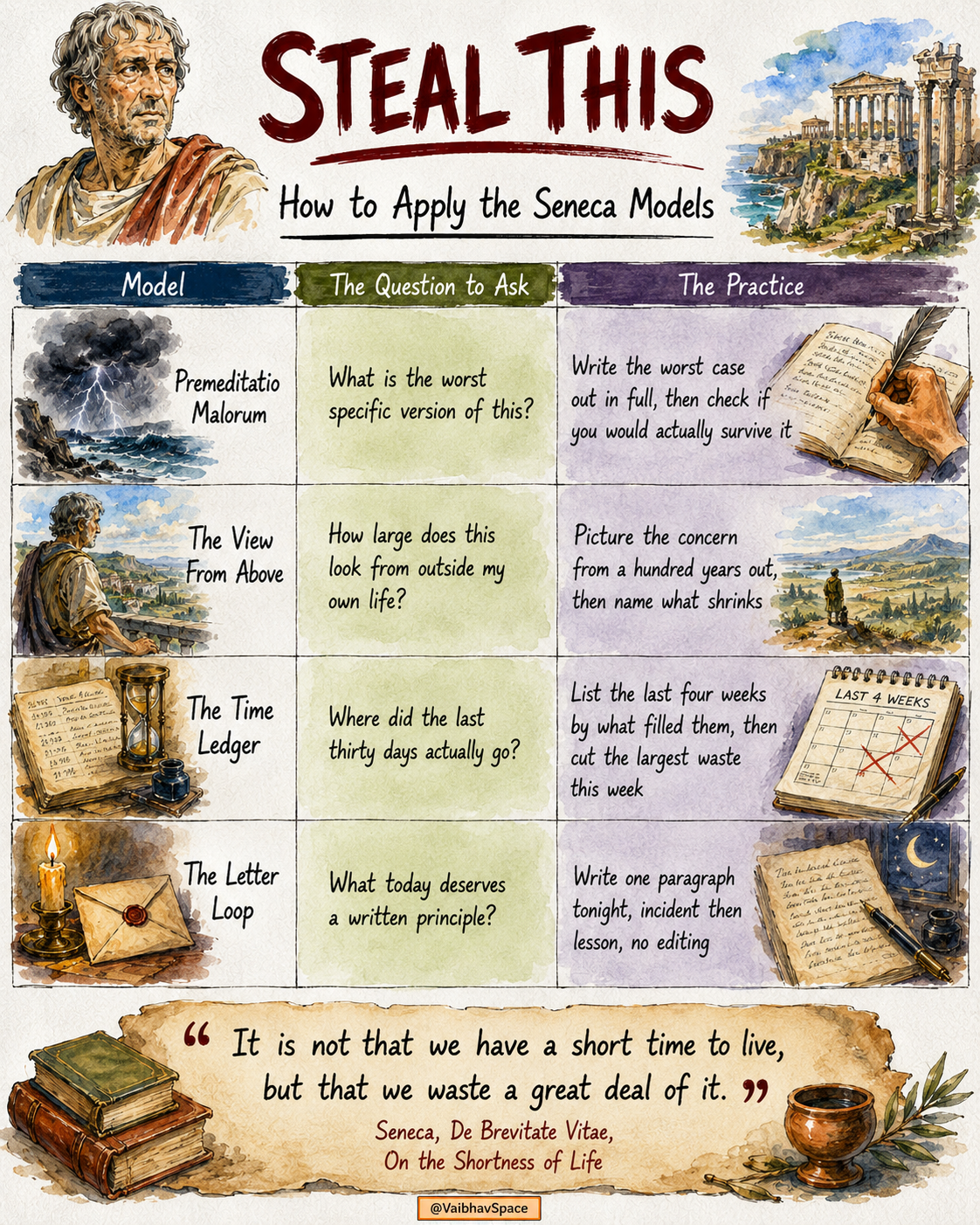
How to Apply the Seneca Models

Model
The Question to Ask
The Practice
Premeditatio Malorum
What is the worst specific version of this?
Write the worst case out in full, then check if you would actually survive it
The View From Above
How large does this look from outside my own life?
Picture the concern from a hundred years out, then name what shrinks
The Time Ledger
Where did the last thirty days actually go?
List the last four weeks by what filled them, then cut the largest waste this week
The Letter Loop
What today deserves a written principle?
Write one paragraph tonight, incident then lesson, no editing

"It is not that we have a short time to live, but that we waste a great deal of it."

Seneca, De Brevitate Vitae, On the Shortness of Life

The Stoic Who Kept Quoting His Rivals

Nearly every early letter to Lucilius closes with a maxim, and a surprising number of them are borrowed from Epicurus, founder of the rival school Stoics traditionally treated as the enemy camp.

Seneca's justification, given directly in Letter 16: whatever is well said by anyone is mine. He treated philosophy as a toolkit assembled from whatever actually worked, not a flag to defend.

That habit, cross-reading a rival school for usable psychology instead of debating points, is easy to miss because it runs against how most people treat intellectual identity, then and now.

Stoicism

His home school. Virtue is the only true good, everything else is indifferent.

Epicureanism

The rival school, quoted anyway. Letter 16: "Whatever is well said by anyone is mine."

Roman Tragedy

He wrote eight surviving plays, Thyestes among them, using myth as case studies in unchecked passion.

Natural Science

Naturales Quaestiones. Earthquakes and comets used to relativize human affairs.

The Combination

A working therapy for one honest reader, assembled from whatever actually held up, regardless of which school wrote it first.

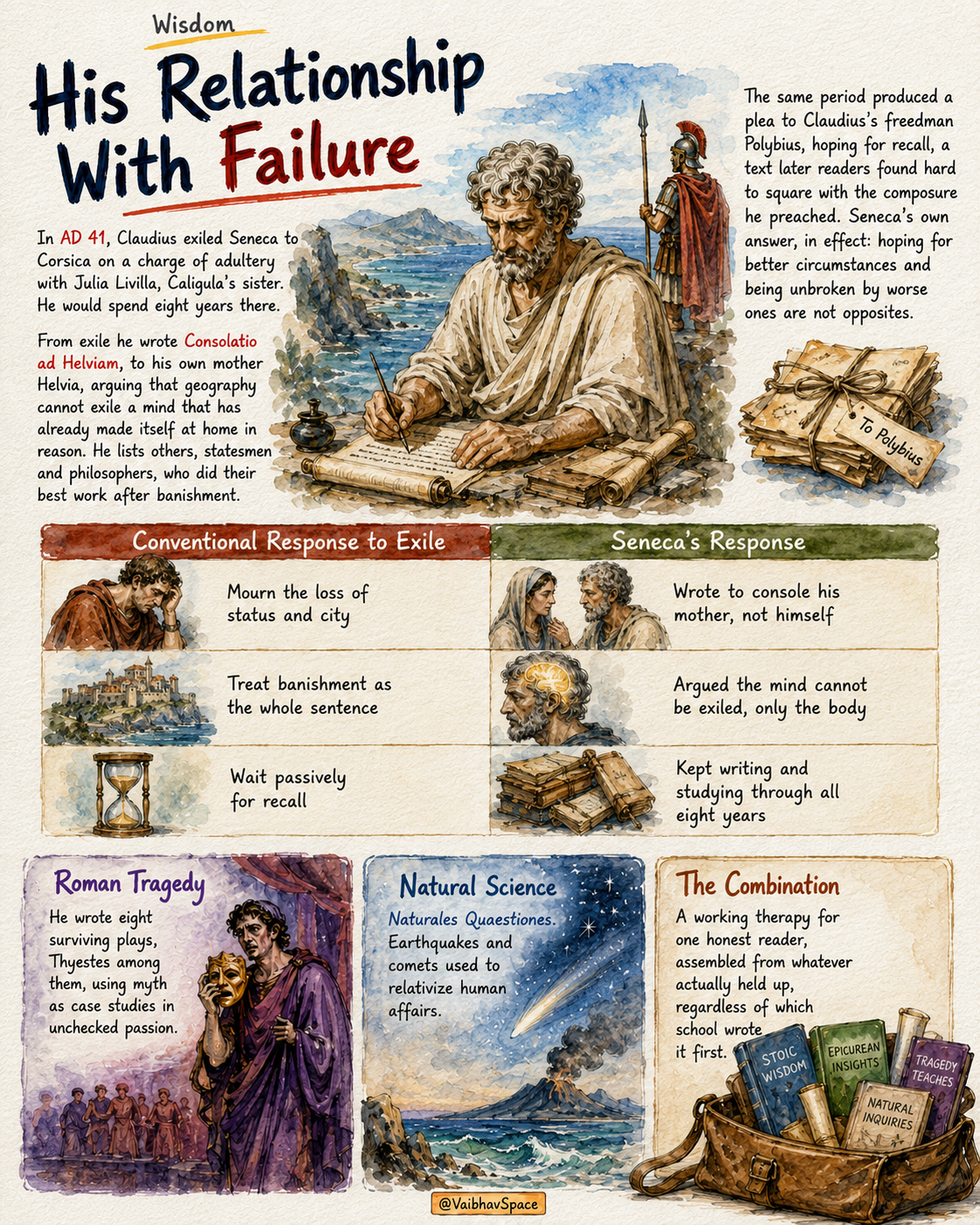
His Relationship With Failure

Conventional Response to Exile
Seneca's Response
Mourn the loss of status and city
Wrote to console his mother, not himself
Treat banishment as the whole sentence
Argued the mind cannot be exiled, only the body
Wait passively for recall
Kept writing and studying through all eight years

In AD 41, Claudius exiled Seneca to Corsica on a charge of adultery with Julia Livilla, Caligula's sister. He would spend eight years there.

From exile he wrote Consolatio ad Helviam, to his own mother Helvia, arguing that geography cannot exile a mind that has already made itself at home in reason. He lists others, statesmen and philosophers, who did their best work after banishment.

The same period produced a plea to Claudius's freedman Polybius, hoping for recall, a text later readers found hard to square with the composure he preached. Seneca's own answer, in effect: hoping for better circumstances and being unbroken by worse ones are not opposites.

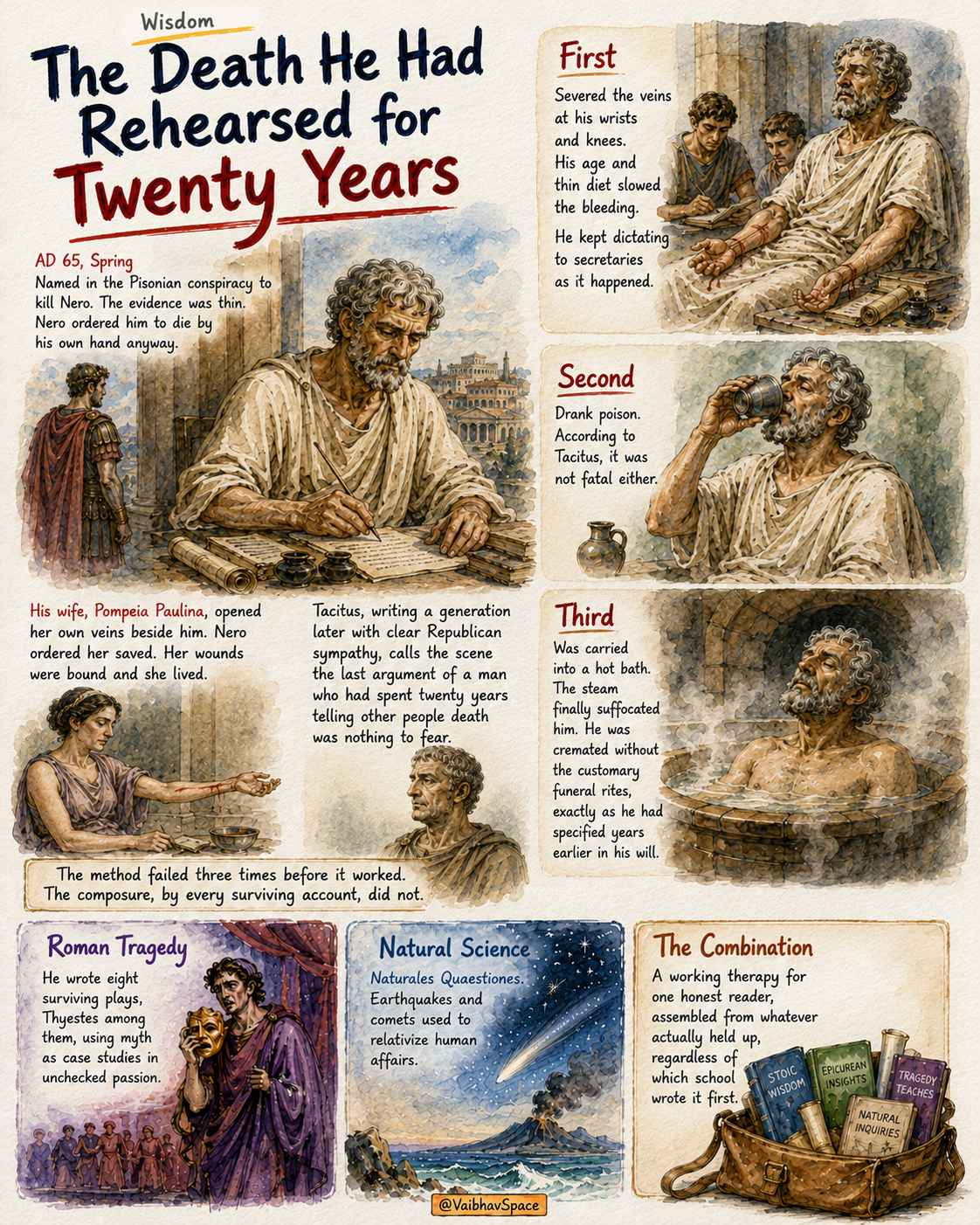
The Death He Had Rehearsed for Twenty Years

AD 65, Spring

Named in the Pisonian conspiracy to kill Nero. The evidence was thin. Nero ordered him to die by his own hand anyway.

First

Severed the veins at his wrists and knees. His age and thin diet slowed the bleeding. He kept dictating to secretaries as it happened.

Second

Drank poison. According to Tacitus, it was not fatal either.

Third

Was carried into a hot bath. The steam finally suffocated him. He was cremated without the customary funeral rites, exactly as he had specified years earlier in his will.

His wife, Pompeia Paulina, opened her own veins beside him. Nero ordered her saved. Her wounds were bound and she lived.

Tacitus, writing a generation later with clear Republican sympathy, calls the scene the last argument of a man who had spent twenty years telling other people death was nothing to fear.

The method failed three times before it worked. The composure, by every surviving account, did not.

My take Vaibhav Bodana @vaibhavspace

Seneca's models still work. Premeditatio malorum alone has saved me from a dozen spirals before they started. But I don't buy the framing that his wealth was just Stoic indifference in practice. You don't call in a forty million sesterce loan on people who never wanted it and still get to lecture the rest of us about desire.

What I'm stealing is the letter loop. One incident, one principle, written the same day, no polishing. It's the only discipline on this page that doesn't need you to already be calm to start.

What I can't unsee is Letter 91 and the Boudica loan sitting in the same decade. He rehearsed his own ruin for twenty years. He was less careful about rehearsing what his money did to people who never met him.

Section 1
Section 1
Section 1
Section 1
Section 1
Section 1
Section 1
Section 1
Section 1
Section 1
Section 1