Vedic Steal Their Minds → Mental Models • Wisdom • Perspectives
विश्वामित्र

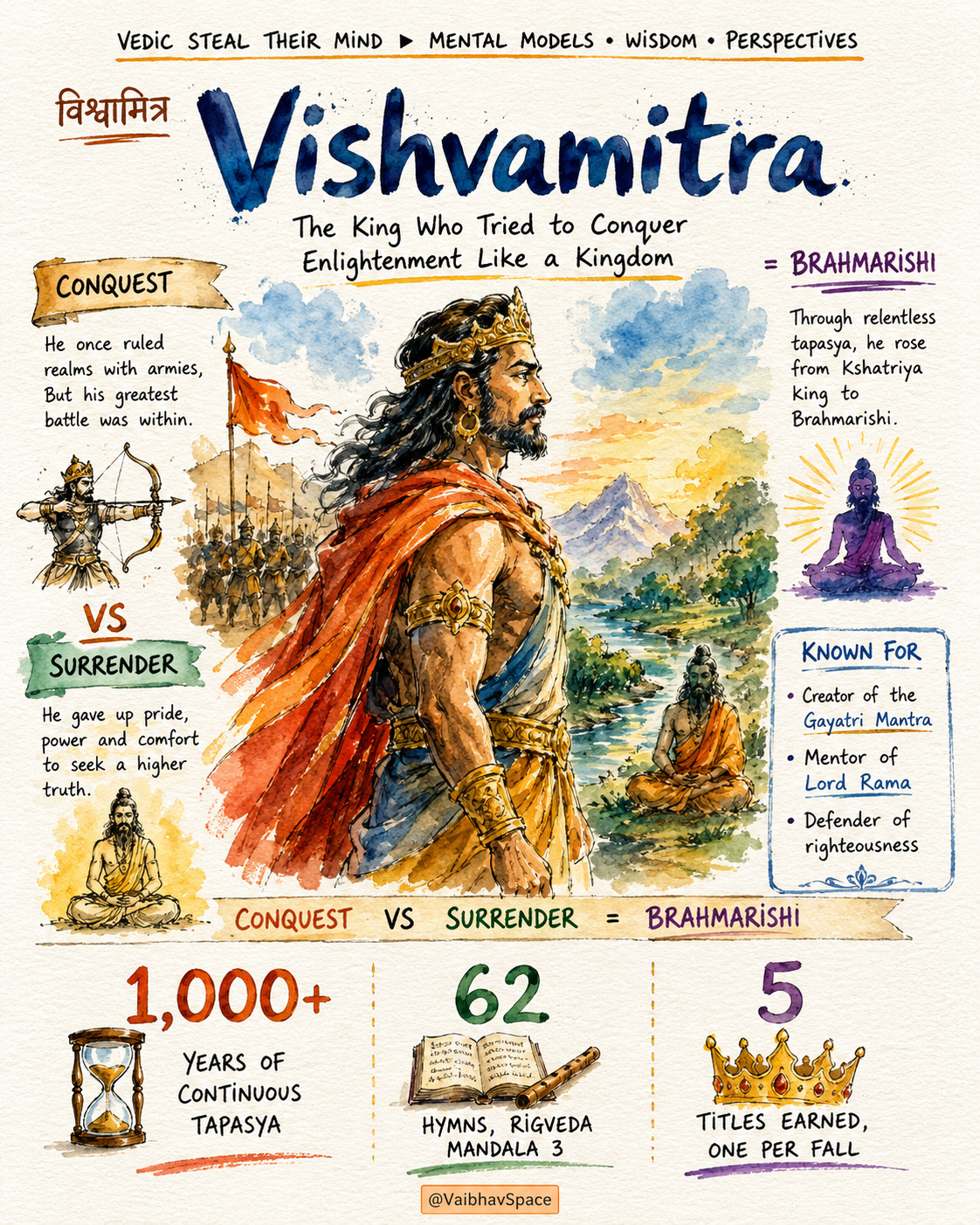
Vishvamitra

The King Who Tried to Conquer Enlightenment Like a Kingdom

CONQUEST vs SURRENDER = BRAHMARISHI
1,000+ Years of continuous tapasya
62 Hymns, Rigveda Mandala 3
5 Titles earned, one per fall
01 / The Core Model

The Ladder of Titles

Vishvamitra began as King Kaushika of Kanyakubja, a Kshatriya ruler with an army, a treasury, and a lineage going back to Kusha. On a stop at sage Vasishtha's hermitage, he saw the sage's cow Kamadhenu feed his entire army from nothing. He asked for the cow. Vasishtha refused. Kaushika ordered his soldiers to take her by force, and lost his army twice.

That defeat convinced him that a Brahmarishi's power outranked a king's. So he applied a king's method to a sage's problem: escalate, extend the campaign, refuse to stop. Traditional accounts place Mandala 3 of the Rigveda, most of which is credited to him, in the early Vedic family-book period, roughly 1500 to 1000 BCE, though exact dating for the man himself is contested and largely traditional.

What followed was five ranks, and he earned each one only after losing something at the last. Rajarshi first, then Rishi, then Maharshi, then Brahmarishi, granted by Brahma after more than a thousand years of penance in the Himalayas.
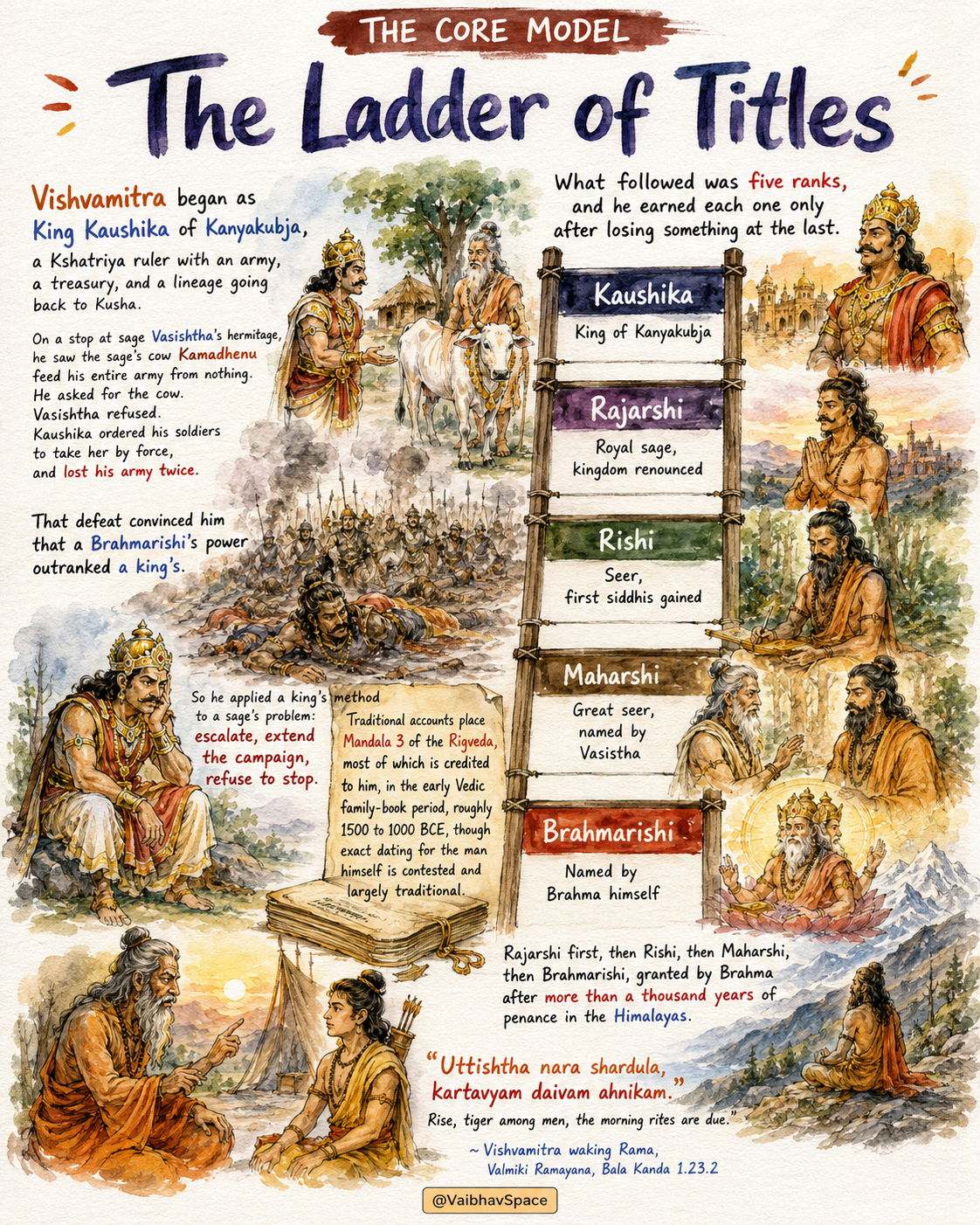
KaushikaKing of Kanyakubja
RajarshiRoyal sage, kingdom renounced
RishiSeer, first siddhis gained
MaharshiGreat seer, named by Vasishtha
BrahmarishiNamed by Brahma himself

"Uttishtha nara shardula, kartavyam daivam ahnikam." Rise, tiger among men, the morning rites are due.

Vishvamitra waking Rama, Valmiki Ramayana, Bala Kanda 1.23.2
02 / Mental Model

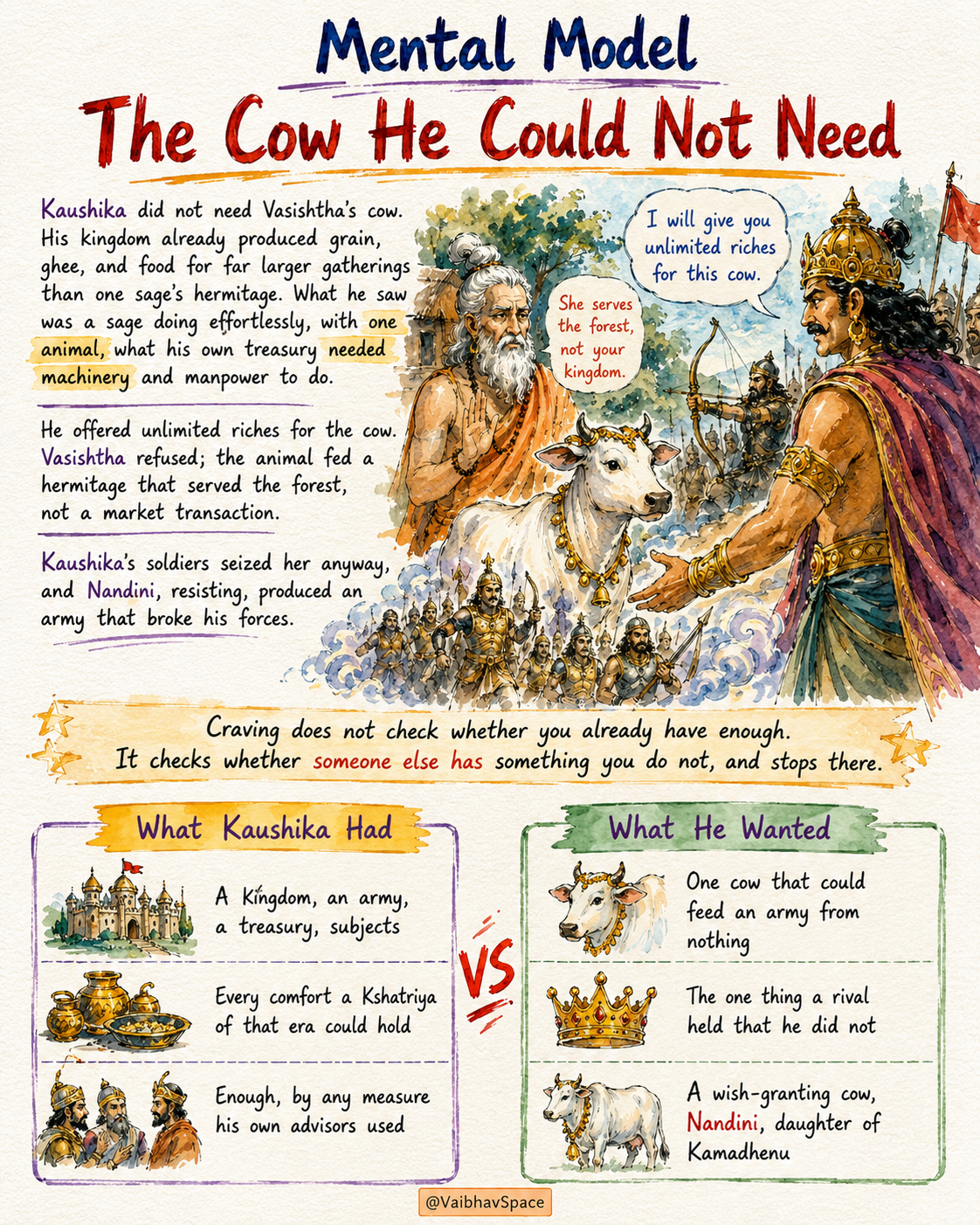
The Cow He Could Not Need

What Kaushika Had
What He Wanted
A kingdom, an army, a treasury, subjects
One cow that could feed an army from nothing
Every comfort a Kshatriya of that era could hold
The one thing a rival held that he did not
Enough, by any measure his own advisors used
A wish-granting cow, Nandini, daughter of Kamadhenu

Kaushika did not need Vasishtha's cow. His kingdom already produced grain, ghee, and food for far larger gatherings than one sage's hermitage. What he saw was a sage doing effortlessly, with one animal, what his own treasury needed machinery and manpower to do.

He offered unlimited riches for the cow. Vasishtha refused; the animal fed a hermitage that served the forest, not a market transaction. Kaushika's soldiers seized her anyway, and Nandini, resisting, produced an army that broke his forces.

Craving does not check whether you already have enough. It checks whether someone else has something you do not, and stops there.

03 / Mental Model

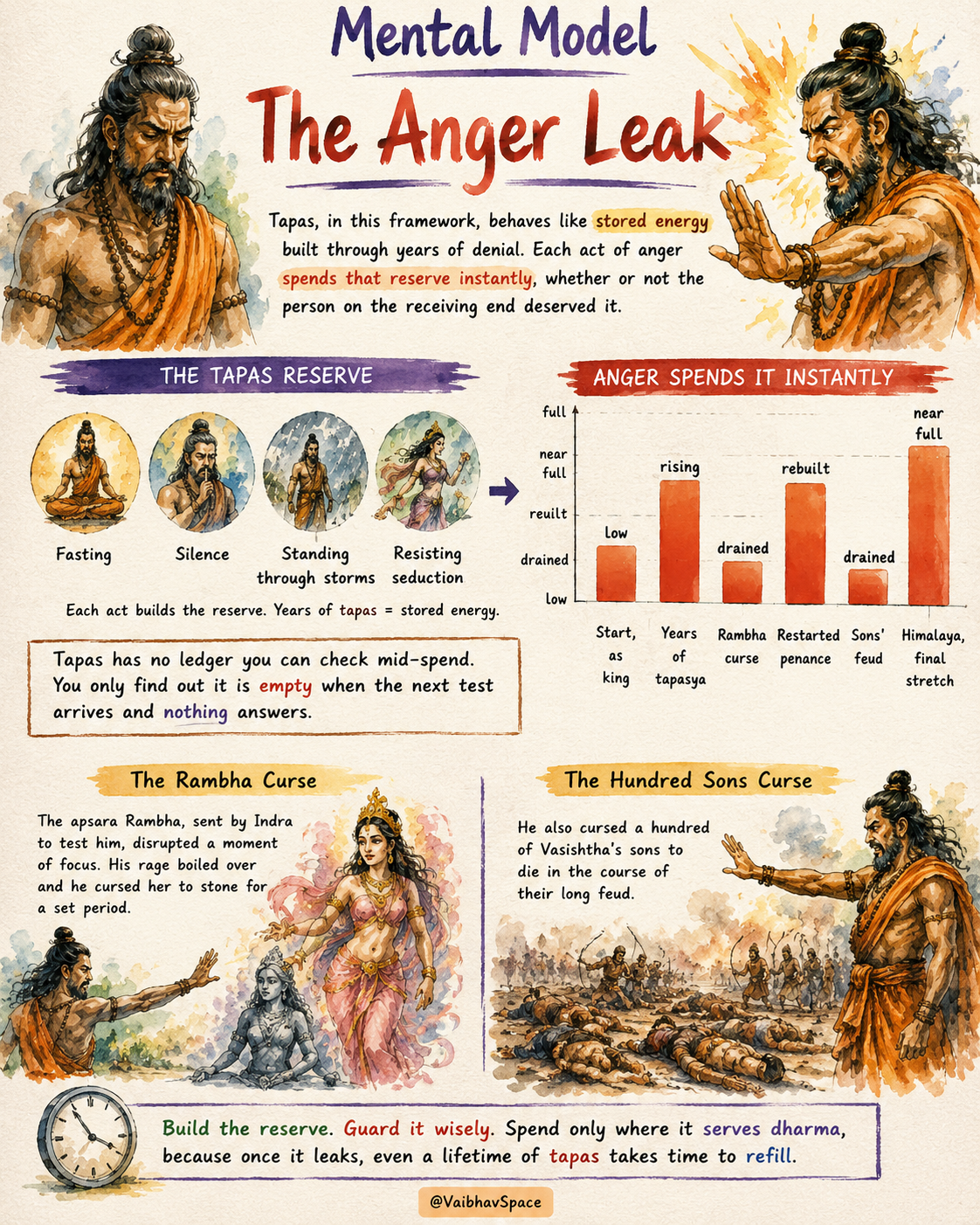
The Anger Leak

Tapas, in this framework, behaves like stored energy built through years of denial: fasting, silence, standing through storms, resisting seduction. Each act of anger spends that reserve instantly, whether or not the person on the receiving end deserved it.

Vishvamitra's temper cost him repeatedly. When the apsara Rambha, sent by Indra to test him, disrupted a moment of focus, his rage boiled over and he cursed her to stone for a set period. He also cursed a hundred of Vasishtha's sons to die in the course of their long feud.

Tapas has no ledger you can check mid-spend. You only find out it is empty when the next test arrives and nothing answers.

lowStart, as king
risingYears of tapasya
drainedRambha curse
rebuiltRestarted penance
drainedSons' curse, feud
near fullHimalaya, final stretch
04 / Mental Model

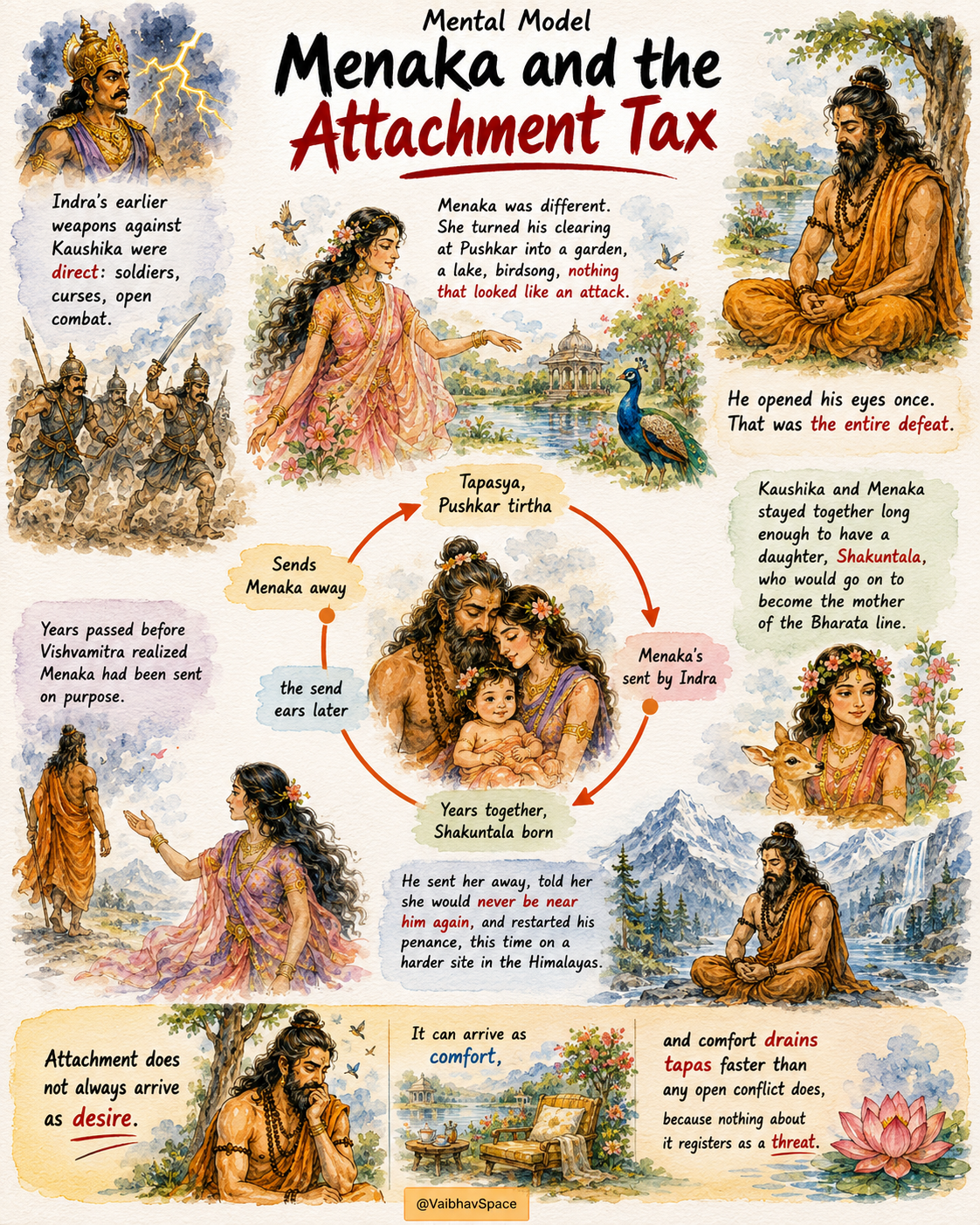
Menaka and the Attachment Tax

Tapasya, Pushkar tirtha Menaka's garden sent by Indra Years together, Shakuntala born Realizes the send years later Sends Menaka away

Indra's earlier weapons against Kaushika were direct: soldiers, curses, open combat. Menaka was different. She turned his clearing at Pushkar into a garden, a lake, birdsong, nothing that looked like an attack.

He opened his eyes once. That was the entire defeat. Kaushika and Menaka stayed together long enough to have a daughter, Shakuntala, who would go on to become the mother of the Bharata line. Years passed before Vishvamitra realized Menaka had been sent on purpose. He sent her away, told her she would never be near him again, and restarted his penance, this time on a harder site in the Himalayas.

Attachment does not always arrive as desire. It can arrive as comfort, and comfort drains tapas faster than any open conflict does, because nothing about it registers as a threat.

05 / Mental Model

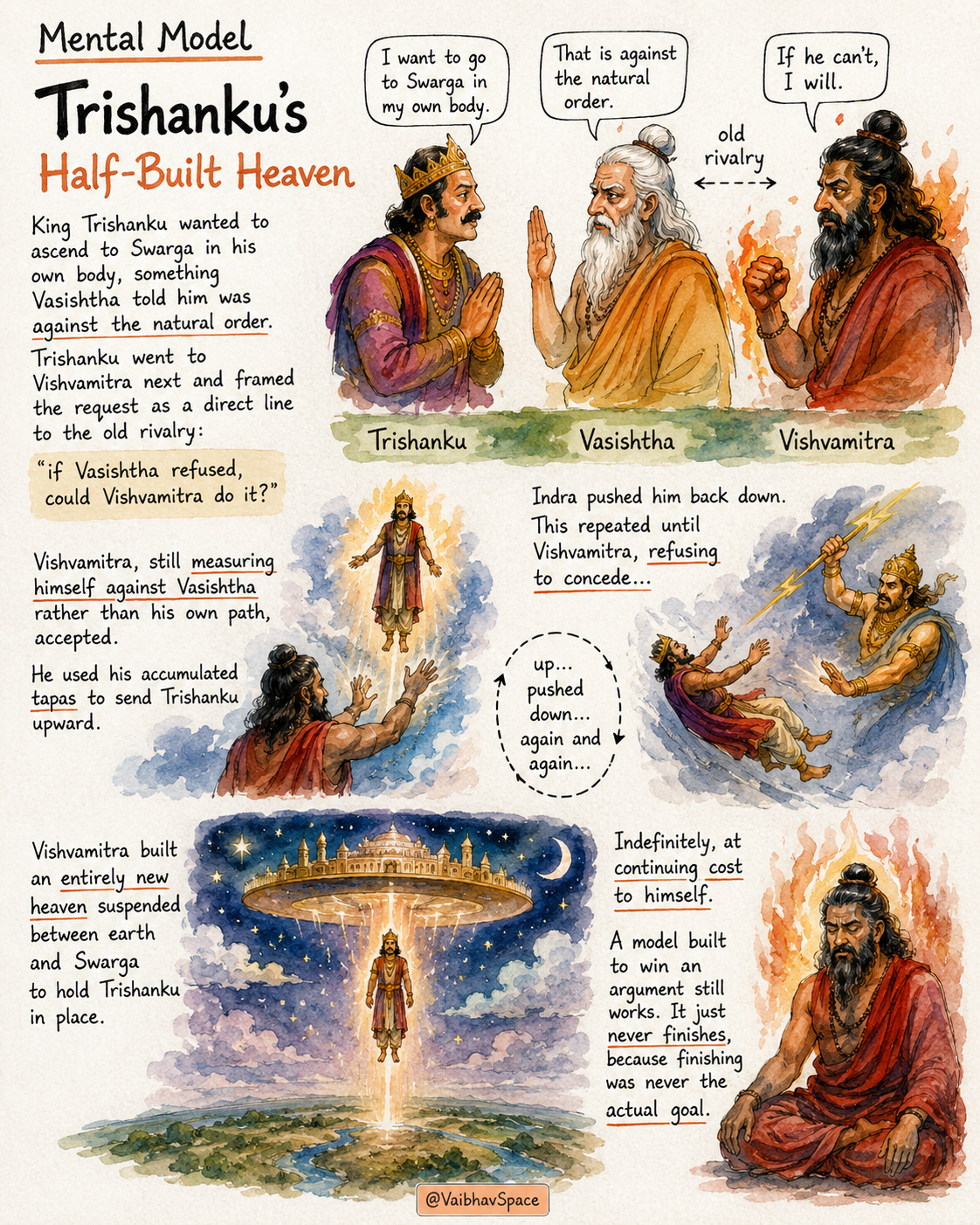
Trishanku's Half-Built Heaven

King Trishanku wanted to ascend to Swarga in his own body, something Vasishtha told him was against the natural order. Trishanku went to Vishvamitra next and framed the request as a direct line to the old rivalry: if Vasishtha refused, could Vishvamitra do it?

Vishvamitra, still measuring himself against Vasishtha rather than his own path, accepted. He used his accumulated tapas to send Trishanku upward. Indra pushed him back down. This repeated until Vishvamitra, refusing to concede, built an entirely new heaven suspended between earth and Swarga to hold Trishanku in place, indefinitely, at continuing cost to himself.

A model built to win an argument still works. It just never finishes, because finishing was never the actual goal.

Swarga Trishanku pushed up by Vishvamitra pulled down by Indra Earth
06 / The Blind Spot

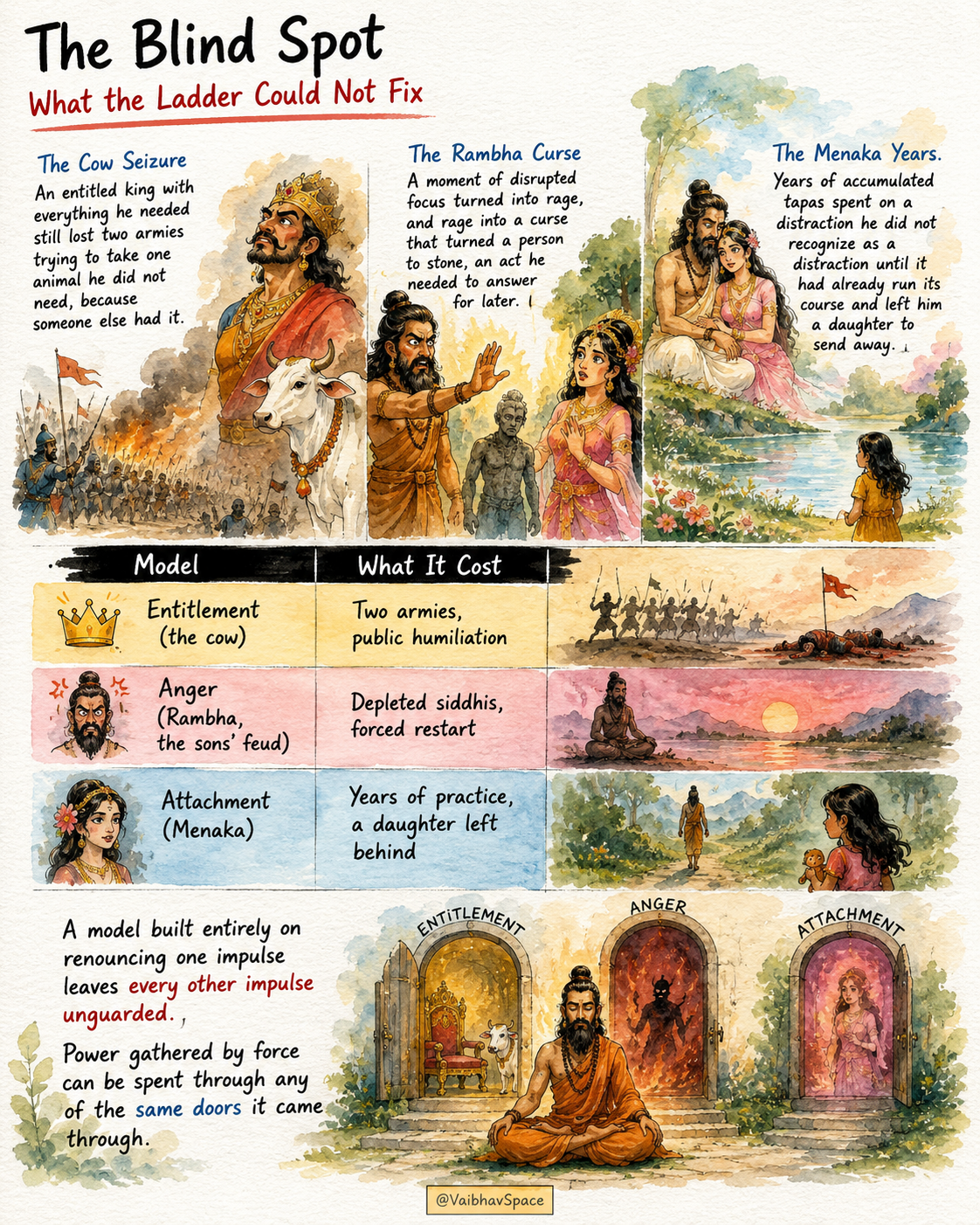
What the Ladder Could Not Fix

The Cow Seizure. An entitled king with everything he needed still lost two armies trying to take one animal he did not need, because someone else had it.

The Rambha Curse. A moment of disrupted focus turned into rage, and rage into a curse that turned a person to stone, an act he needed to answer for later.

The Menaka Years. Years of accumulated tapas spent on a distraction he did not recognize as a distraction until it had already run its course and left him a daughter to send away.

Model
What It Cost
Entitlement (the cow)
Two armies, public humiliation
Anger (Rambha, the sons' feud)
Depleted siddhis, forced restart
Attachment (Menaka)
Years of practice, a daughter left behind
A model built entirely on renouncing one impulse leaves every other impulse unguarded. Power gathered by force can be spent through any of the same doors it came through.
07 / Steal This

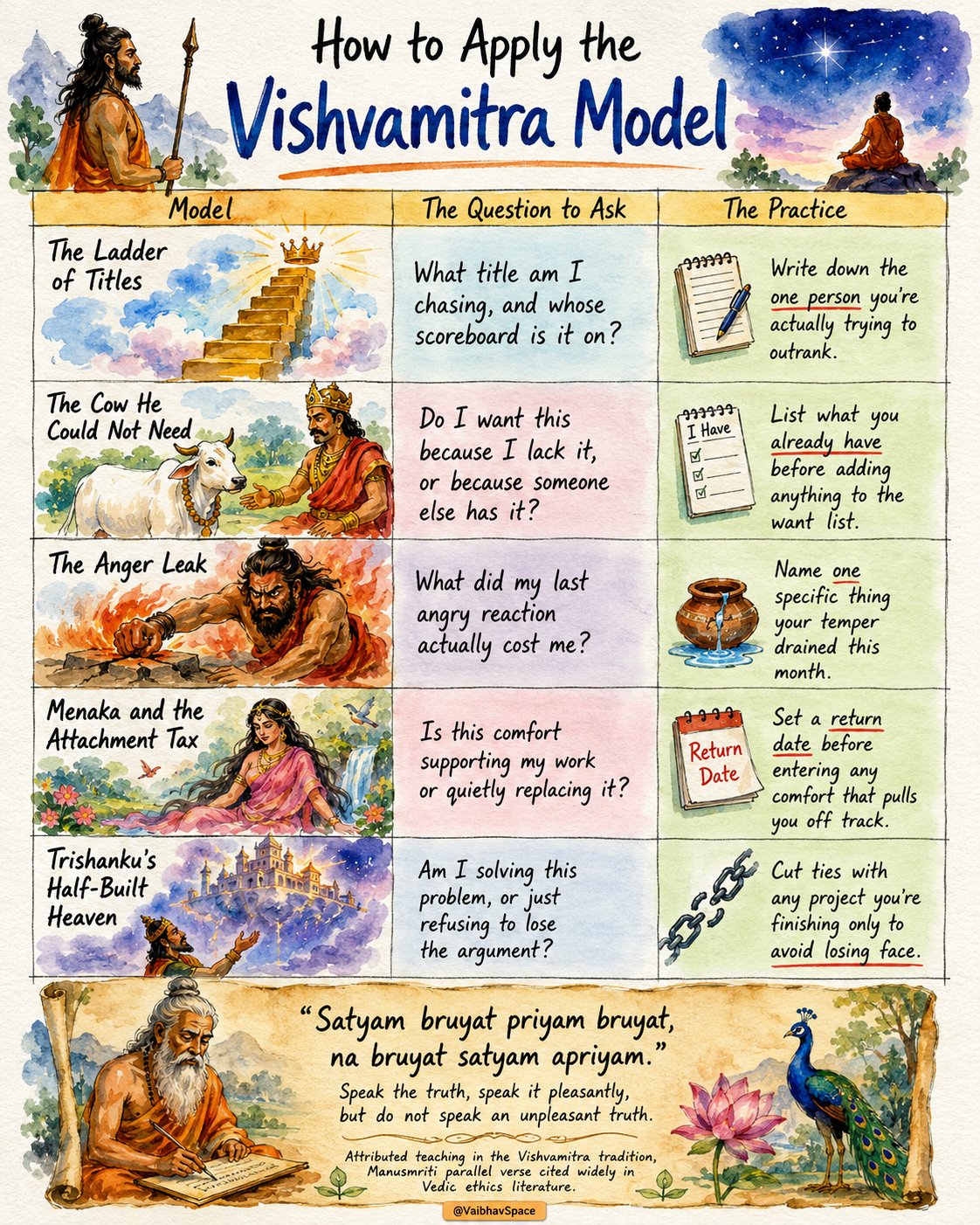
How to Apply the Vishvamitra Model

Model
The Question to Ask
The Practice
The Ladder of Titles
What title am I chasing, and whose scoreboard is it on?
Write down the one person you're actually trying to outrank.
The Cow He Could Not Need
Do I want this because I lack it, or because someone else has it?
List what you already have before adding anything to the want list.
The Anger Leak
What did my last angry reaction actually cost me?
Name one specific thing your temper drained this month.
Menaka and the Attachment Tax
Is this comfort supporting my work or quietly replacing it?
Set a return date before entering any comfort that pulls you off track.
Trishanku's Half-Built Heaven
Am I solving this problem, or just refusing to lose the argument?
Cut ties with any project you're finishing only to avoid losing face.

"Satyam bruyat priyam bruyat, na bruyat satyam apriyam." Speak the truth, speak it pleasantly, but do not speak an unpleasant truth.

Attributed teaching in the Vishvamitra tradition, Manusmriti parallel verse cited widely in Vedic ethics literature
08 / Wisdom

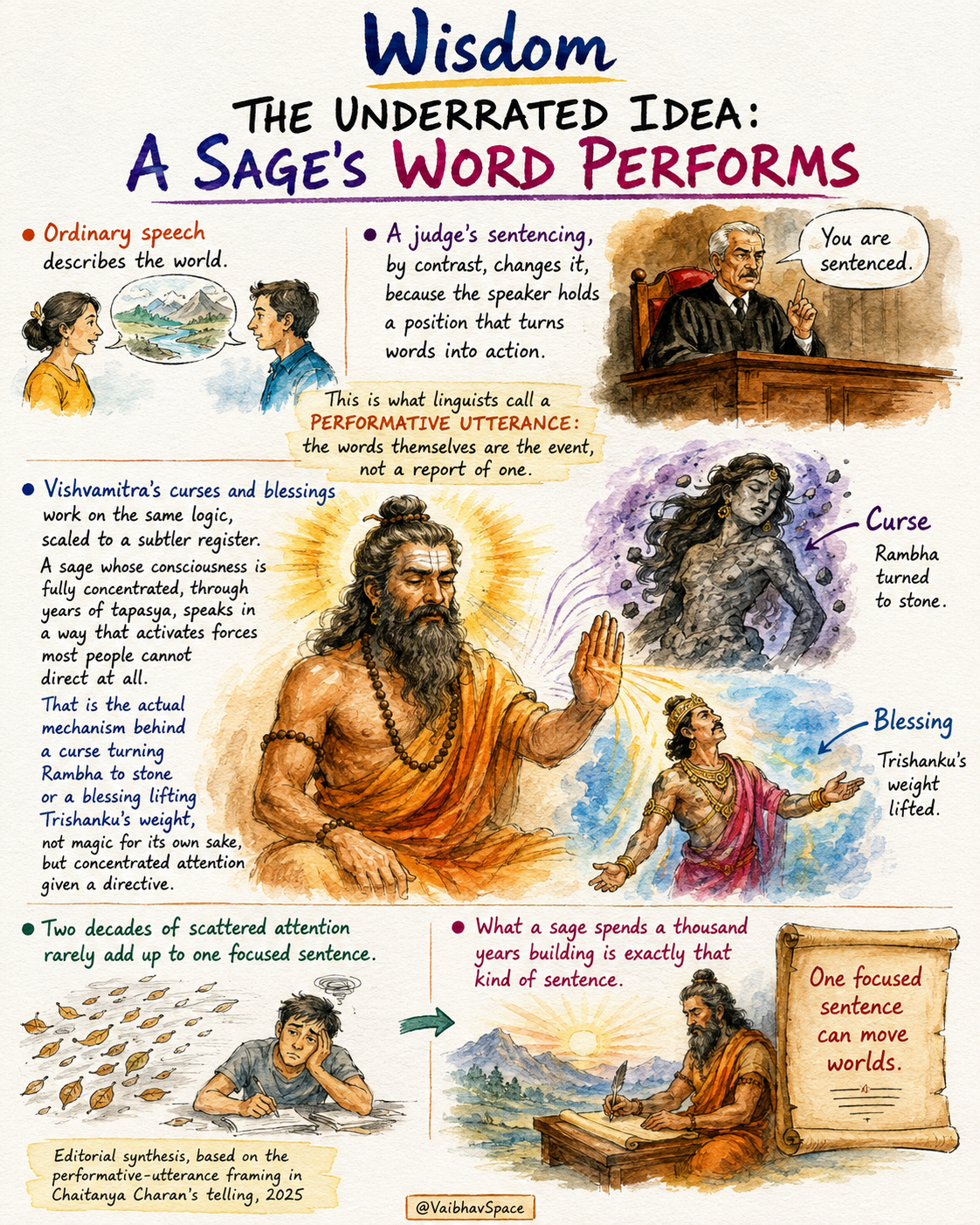
The Underrated Idea: A Sage's Word Performs

Ordinary speech describes the world. A judge's sentencing, by contrast, changes it, because the speaker holds a position that turns words into action. This is what linguists call a performative utterance: the words themselves are the event, not a report of one.

Vishvamitra's curses and blessings work on the same logic, scaled to a subtler register. A sage whose consciousness is fully concentrated, through years of tapasya, speaks in a way that activates forces most people cannot direct at all. That is the actual mechanism behind a curse turning Rambha to stone or a blessing lifting Trishanku's weight, not magic for its own sake, but concentrated attention given a directive.

Two decades of scattered attention rarely add up to one focused sentence. What a sage spends a thousand years building is exactly that kind of sentence.

Editorial synthesis, based on the performative-utterance framing in Chaitanya Charan's telling, 2025
09 / Wisdom

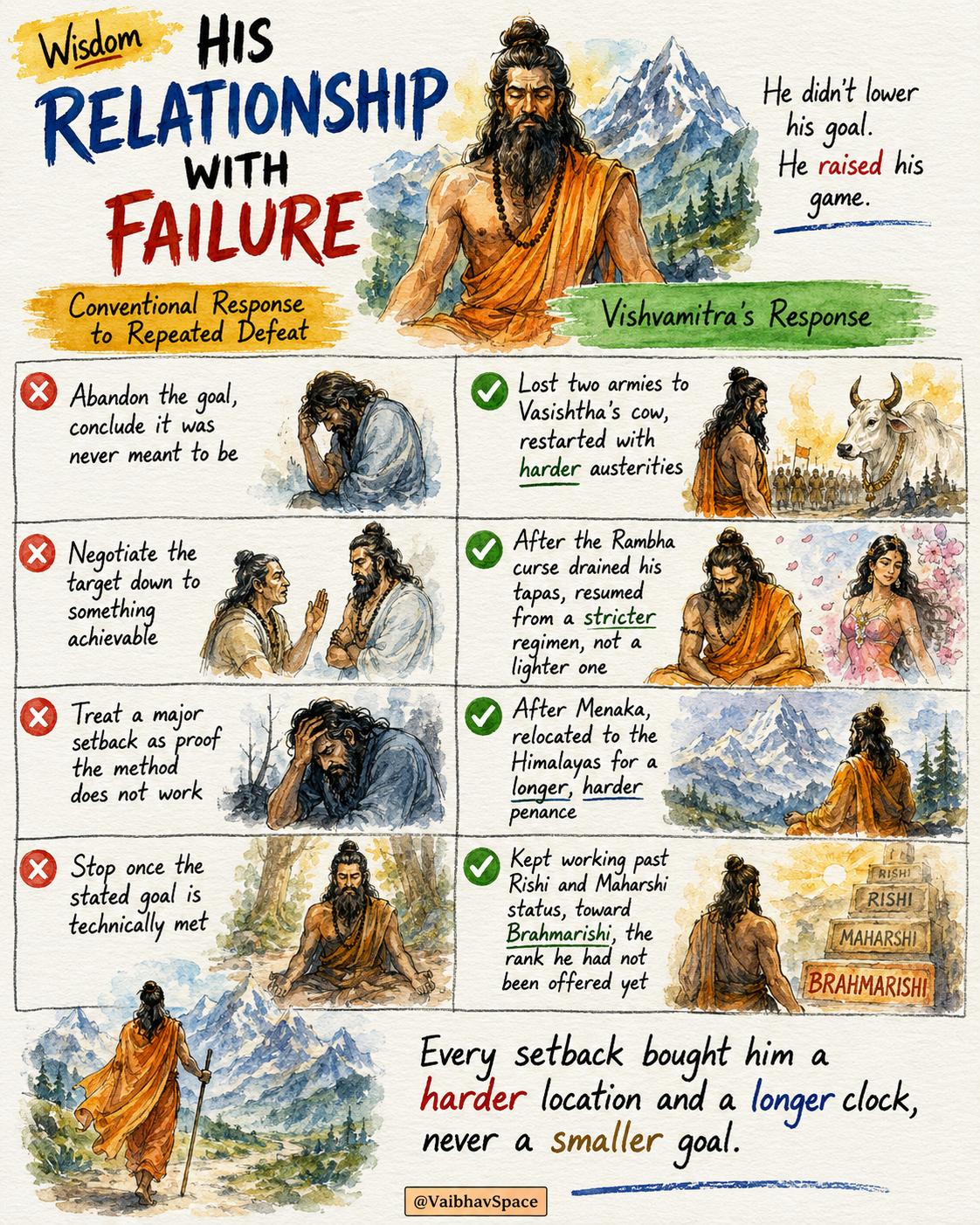
His Relationship With Failure

Conventional Response to Repeated Defeat
Vishvamitra's Response
Abandon the goal, conclude it was never meant to be
Lost two armies to Vasishtha's cow, restarted with harder austerities
Negotiate the target down to something achievable
After the Rambha curse drained his tapas, resumed from a stricter regimen, not a lighter one
Treat a major setback as proof the method does not work
After Menaka, relocated to the Himalayas for a longer, harder penance
Stop once the stated goal is technically met
Kept working past Rishi and Maharshi status, toward Brahmarishi, the rank he had not been offered yet

Every setback bought him a harder location and a longer clock, never a smaller goal.

10 / Wisdom

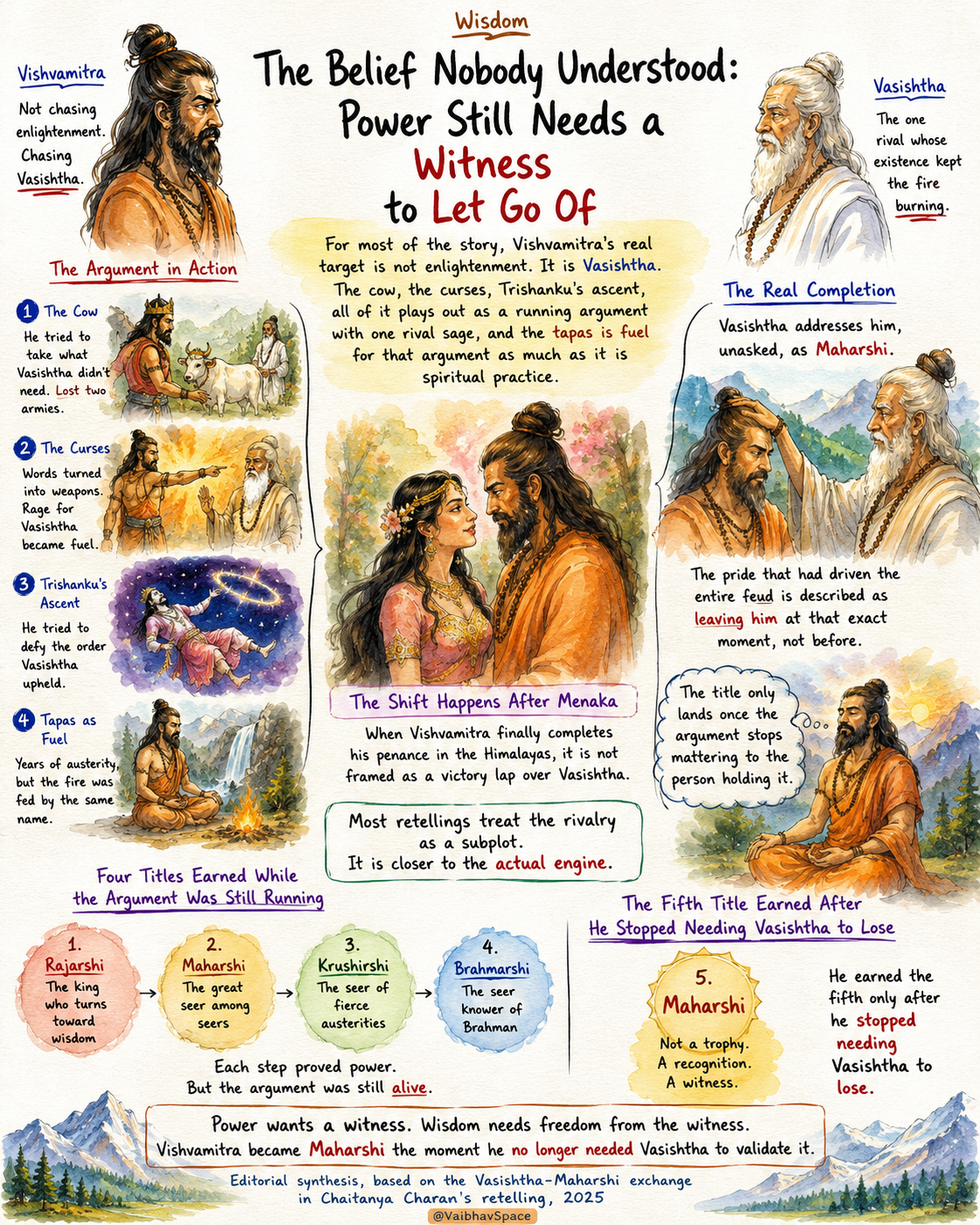
The Belief Nobody Understood: Power Still Needs a Witness to Let Go Of

For most of the story, Vishvamitra's real target is not enlightenment. It is Vasishtha. The cow, the curses, Trishanku's ascent, all of it plays out as a running argument with one rival sage, and the tapas is fuel for that argument as much as it is spiritual practice.

The shift happens only after Menaka. When Vishvamitra finally completes his penance in the Himalayas, it is not framed as a victory lap over Vasishtha. Vasishtha addresses him, unasked, as Maharshi. The pride that had driven the entire feud is described as leaving him at that exact moment, not before.

Most retellings treat the rivalry as a subplot. It is closer to the actual engine. The title only lands once the argument stops mattering to the person holding it.

He earned four titles while the argument was still running. He earned the fifth only after he stopped needing Vasishtha to lose.

Editorial synthesis, based on the Vasishtha-Maharshi exchange in Chaitanya Charan's retelling, 2025

My Take

@vaibhavspace

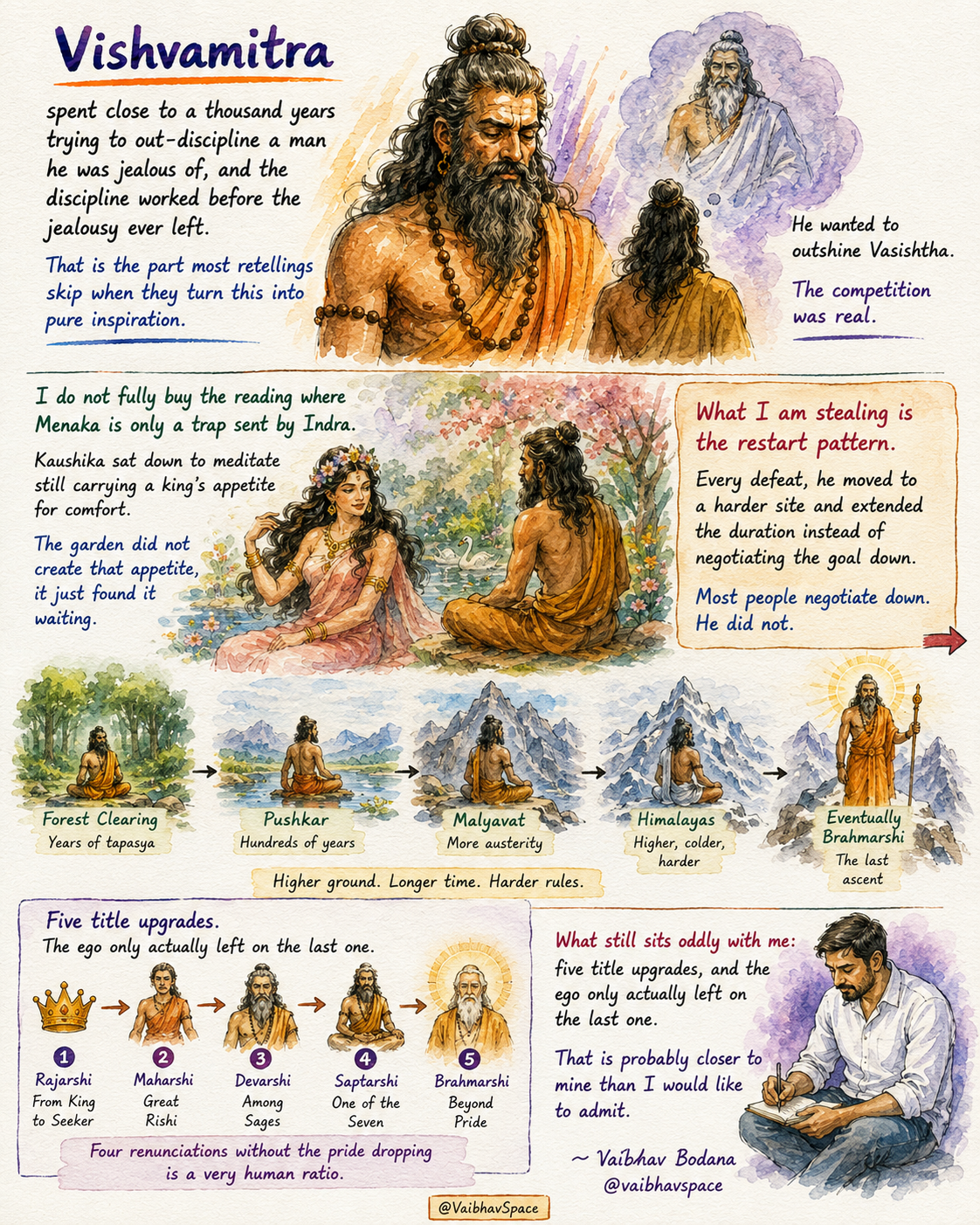
Vishvamitra spent close to a thousand years trying to out-discipline a man he was jealous of, and the discipline worked before the jealousy ever left. That is the part most retellings skip when they turn this into pure inspiration.

I do not fully buy the reading where Menaka is only a trap sent by Indra. Kaushika sat down to meditate still carrying a king's appetite for comfort. The garden did not create that appetite, it just found it waiting.

What I am stealing is the restart pattern. Every defeat, he moved to a harder site and extended the duration instead of negotiating the goal down. Most people negotiate down. What still sits oddly with me: five title upgrades, and the ego only actually left on the last one. Four renunciations without the pride dropping is a very human ratio, and it is probably closer to mine than I would like to admit.

Section 1
Section 1
Section 1
Section 1
Section 1
Section 1
Section 1
Section 1
Section 1
Section 1
Section 1
Section 1