Jambudvipa-in-Prajnapti-Sutra↗
I first read about the Jambudvipa Prajnapti Sutra a few years ago, in a footnote, of all places. I almost skipped it. A Jain cosmography text, 3rd century BCE, sounds like homework. But once you sit with what it’s actually claiming, something shifts.
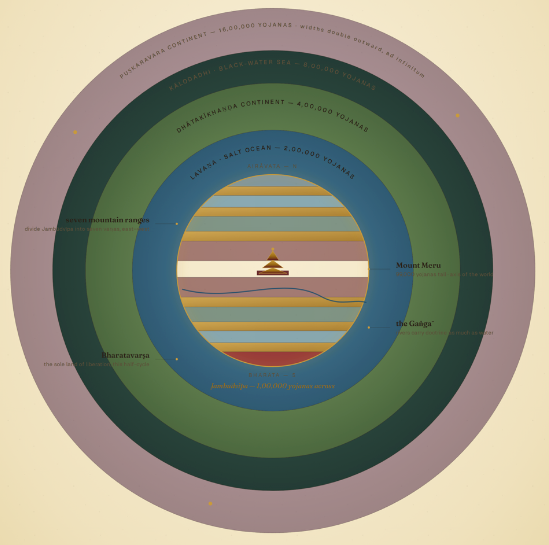
Jambudvipa, the Rose Apple Continent, spans 100,000 yojanas. At its center stands Mount Meru, 99,000 yojanas tall. Seven mountain ranges cut the land into varshas, regions, and only one of them, Bharatavarsha, permits liberation. Not six others equally valid. One. Beyond this continent lie concentric oceans, each doubling the width of the last, some filled with milk, some with ghee, some with sugarcane juice. The math never lets up: geometric doubling, planetary orbits, eclipse cycles, all counted out in the same breath as the mythology.
Why does a religious text need this much arithmetic? Well, because for the Jains who compiled it, precision was itself a form of devotion.
I was tempted, at first, to read this as pure fantasy, numbers stacked for their own sake. But that dismissal doesn’t survive contact with the text. Consider this: the sutra was composed during real rivalry with Buddhist cosmology, possibly under Greek astronomical influence moving through northwest India. This wasn’t invention in a vacuum. It was argument, dressed as geography.
And the geography is never just geography. Mountains stand in for obstacles. Oceans represent attachment, the thing that keeps you circling instead of arriving. Rivers, like the Ganga, carry teaching downstream to whoever will receive it. Liberation possible only from certain regions. That is not an accident of cartography. That is theology wearing a map’s clothes.
So what do we do with a text like this today, one built for oral transmission by monks reciting Mahavira’s dialogue, centuries before it was fixed in writing at the Council of Valabhi?
First, resist the urge to extract “the message” and discard the scaffolding, the numbers, the repetition, the sheer structural obsession are the message. Second, notice how the same instinct, that spiritual truth needs geometric rigor to be trustworthy, shows up in Samvasarana-patas and temple architecture centuries later. Lastly, and most importantly, recognize that a community willing to memorize orbital calculations to preserve a worldview was not being credulous. It was being disciplined.
We will not fully recover what it felt like to recite these verses by firelight, layer after layer, across four centuries of transmission. But we can still learn from the discipline behind them. That, at least, travels intact.
—
Some key texts that describe Jambudvipa in detail:
Jain sources (most detailed cosmological descriptions):
- Jambudvipa Prajnapti Sutra (dedicated entirely to this topic)
- Tiloya Pannatti (Tiloyapannatti) by Yativrishabha
- Trilokasara by Nemichandra
- Jiva Vichara / Kshetra Samas texts
- Brihat Sangrahani
Hindu Puranic sources:
- Vishnu Purana (Book II)
- Bhagavata Purana (5th Skandha)
- Vayu Purana
- Markandeya Purana
- Surya Siddhanta (for astronomical/geographical aspects)
Buddhist sources:
- Abhidharmakosha by Vasubandhu (describes Jambudvipa within its cosmology)