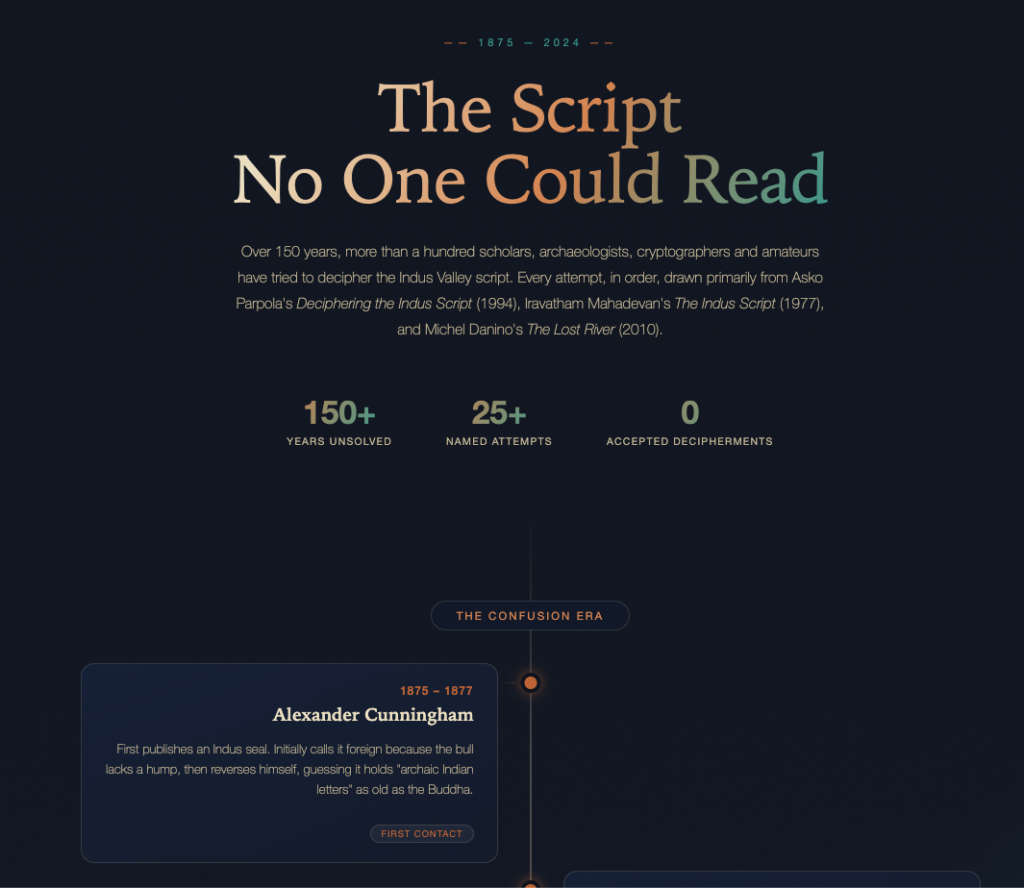
150 years, countless scholars, and even a $1 million prize from Tamil Nadu yet the Indus script remains mute. What we truly need is a bilingual stone, a Rosetta‑like key, to finally unlock the voice of this civilization.
TLDR Indus Script chronology, what we have tried so far:
1875 – 1877 – Alexander Cunningham publishes the first known Indus seal, initially calls it foreign, then reverses himself and guesses it holds “archaic Indian letters.”
1920s – Harappa & Mohenjo-daro excavated; a forgotten Bronze Age civilization surfaces, bringing the script to light at scale.
1924 – Sir John Marshall first proposes the civilization was non-Aryan and its language Dravidian.
1934 – G.R. Hunter produces the first serious text edition and concordance of roughly 800 Indus texts.
1934 – Piero Meriggi proposes Brahui (Dravidian) as the script’s language, tries Sumerian/Elamite comparative links.
1964 – Asko Parpola, with brother Simo Parpola and Seppo Koskenniemi (Finnish team), pioneer computer-aided analysis; argue for Dravidian.
1964 – Yurij Knorozov, with Kondratov & Volchok (Soviet team, of Maya-script fame), also run computer analysis, also land on Dravidian.
1970 – 1977 – Iravatham Mahadevan (Tamil scholar) checks readings against museum objects, then builds the most cited sign concordance, also argues Dravidian.
1976 → – Walter Fairservis argues for a proto-Dravidian socio-political/agricultural reading.
1981 – Soviet team’s second report pushes further into concrete Dravidian sign readings.
1980s – 2000s – S.R. Rao claims decipherment via Brahmi/Sanskrit links (widely disputed).
1994 – Parpola consolidates decades of work into “Deciphering the Indus Script,” concludes no attempt has gained wide acceptance.
2004 – Steve Farmer, Richard Sproat, Michael Witzel, “The Collapse of the Indus-Script Thesis” – argues the signs are non-linguistic symbols, not writing; splits the field into “it’s writing” vs “it’s not” camps.
2009 – Rajesh P.N. Rao et al., “Entropic Evidence for Linguistic Structure in the Indus Script” (Science) – statistical pushback against Farmer/Sproat/Witzel.
2010 – Steven Bonta, “The Indus Valley Script: A New Interpretation” – semiotic/markedness approach.
2010 – Michel Danino, “The Lost River” – Sarasvati-basin civilization argument that feeds the script-language debate.
2013 – Rajesh P.N. Rao et al. follow-up computational papers refining the entropy argument.
2018 – Bahata Ansumali Mukhopadhyay argues specific signs represent a Dravidian numeral/fraction system (Palgrave Communications).
2020 – J. Mark Kenoyer, working in the Gregory Possehl tradition, publishes on script origins/development at Harappa (not a full decipherment claim).
2020 – Payel Hembrom, “Indus Valley Civilization Script Decoded” (self-published) – Santali-language decipherment claim.
2021 – Daggumati & Revesz, computational paper on allograph identification.
2022 – 23 – M. Hameed, “The Alphabet of Sindhu Prakrit” – Sindhi-Prakrit alphabet claim.
2024 – Yajnadevam, “A Cryptanalytic Decipherment of the Indus Script” – treats it as a Shannon-style cryptogram, claims a Sanskrit reading of 500+ inscriptions; not peer-consensus accepted.