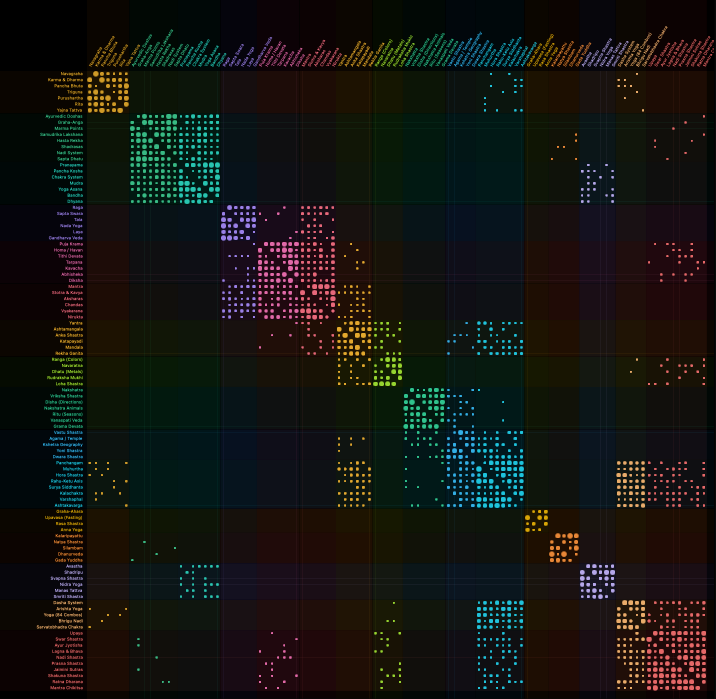
Vedic Knowledge Connection Matrix↗
Einstein chased unification for about 30 years, pouring his energy into a unified field theory that could merge gravity and electromagnetism. He resisted quantum mechanics’ probabilistic nature, believing the universe must be fundamentally orderly, and left behind unfinished manuscripts when he died in 1955. Hawking explored quantum cosmology and black holes for over 50 years, from his singularity theorems in the 1960s to his discovery of Hawking radiation, the black hole information paradox, and finally his finite multiverse theory with Thomas Hertog. His work constantly bridged relativity and quantum mechanics, keeping the “theory of everything” alive in mainstream science. Michio Kaku has been pursuing string field theory for more than 50 years, starting in the 1970s and continuing today. He co‑founded string field theory, advocates it as the strongest candidate for unification, and popularized the quest through books like The God Equation.
Meanwhile, the Indian Vedic Knowledge System already embodies a unified framework: 103 systems, 16 categories, one grid. Clusters like Chakra, Mudra, Yoga Asana are essentially one idea expressed three ways. Astro and Planet share a 70% overlap – the strongest cross‑category link – while Ritual and Language follow at 60%, where every mantra doubles as a grammar lesson. Some pairs barely touch, like Food and Martial Arts, showing almost no overlap across millennia. The tightest knots aren’t the famous systems but the quiet supporting ones — Rudraksha Mukhi, Bhrigu Nadi, Manas Tattva – little‑known names sitting at the very center. They were the quiet supporting ones nobody names in a yoga class.
Seen this way, modern physics’ giants – Einstein, Hawking, Kaku – were chasing what the Vedic grid already demonstrates: once you see the connections instead of categories, the tradition stops looking like a subject list and starts looking like one idea spoken sixteen different ways.